Improving Optical Fiber Bandwidth
Jim Landwehr
Scott Vander Wiel
Multi-mode Fiber
Lucent produces optical fiber as a central
element of high speed, high volume data networks. Though multi-mode
fiber is more difficult to produce than its single-mode cousin, it
remains an economical choice for local area networks because its large
core diameter is compatible with inexpensive connectors and light
sources.
We have been analyzing data from multi-mode fibers and preforms to
understand how subtle changes in a refractive index profile can
degrade fiber bandwidth. Our modeling work will facilitate
fine-tuning the lathes that produce multi-mode preforms.
Refractive Index Profiles and Bandwidth
The glass core of a multi-mode fiber has a graded refractive index
that decreases radially from the center. The precise shape of this
refractive index profile is critical to the fiber's information
carrying capacity as measured by bandwidth. Refractive index profiles
are routinely measured on glass preform rods before they are drawn out
into fiber. A preform consists of many concentric layers of glass
produced sequentially using an MCVD (modified chemical vapor
deposition) process. Index gradations are constructed by
varying the chemical doping in successive layers of
glass. The overall shape of the refractive index profile and its
layer structure are evident in the idealized profile measurement shown
below.
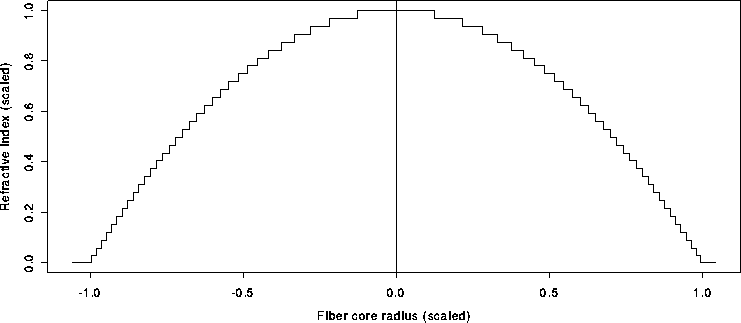
Both the overall shape and the layer structure potentially influence
the bandwidth of fibers drawn from a preform. Optics theory predicts
that a near-quadratic refractive index profile will produce high
bandwidth fibers. The theory, however, is ill-suited to profiles with
layer structure or larger scale departures from the ideal
shape. For this reason profiles need fine-tuning and the work is
somewhat empirical.
Methods for Tuning Lathes
Preform rods are fabricated on lathes.
Two main challenges are present in using preform
profiles to fine-tune a lathe.
- Characterizing the typical profile shape for the
lathe in question.
- Developing a model to predict fiber bandwidth for various
profile shapes.
If our predictions are reliable, then the model
should indicate how to modify a lathe's target profile to improve
bandwidth.
We have developed a scheme for processing several profile
measurements routinely made on each preform. The major steps are
- radial scaling,
- subtracting an ideal quadratic profile,
- smoothing the result, and
- averaging the several smooths for each preform.
Our studies of processed profiles show that a large fraction of the
variation from one to the next on a given lathe is of a simple
multiplicative form that has little impact on bandwidth.
After adjusting for this source of variation, our processed profiles
reveal clear and consistent differences among the lathes.
We have also developed a model to predict bandwidth from (processed)
profile measurements. The model decomposes profile variations into their
principle components and fits a second order response surface to several
of the largest components. For this work we employ statistical model
building and diagnostic tools such as cross-validation,
Cp plots, influence plots, and residual analyses.
We are still working on the model but we expect that it will
usefully guide the tuning of lathes.
The feedback time using
profile measurements will be much shorter than the present
tuning method.