Abstract
Description Logics are logical formalisms for representing information
about classes and objects. Description Logics are often designed to serve
as the basis of implemented knowledge representation systems. However
these systems have been mostly used in research prototypes. Recent
improvements in inference algorithms and computer power have resulted in
new systems based on expressive Description Logics, leading to the
development of OWL, which can be viewed as an expressive Description Logic
designed for use the Semantic Web. This talk will provide an overview of
research in Description Logics, but will delve more deeply into the
developments leading up to OWL.
Two Caveats
-
This talk presents my view of much of the development of the field now
known as Description Logics. I have been involved with most of the
developments in the field, but there have been quite a number of excellent
researchers active in the field, including Ron Brachman, Franz Baader, Ian
Horrocks, and Uli Sattler. I will try to assign credit (and blame) where
it is due, but it is inevitable that some ambiguities and miscommunications
will creep in to this assignment.
-
This talk describes a major portion of my work but there are also other
major efforts in which I have been involved, some related to Description
Logics, some related to other knowledge representation formalisms, and some
unrelated to Artificial Intelligence research at all.
What is a Description Logic?
- Logic-based knowledge representation formalism
- syntax and model-theoretic semantics
- Represents information about classes (a.k.a. concepts), roles
(a.k.a. properties), and objects (a.k.a. individuals)
- Student = Person ∩ ( ∃ enrolledIn EducationalInstitution )
- married ≤ Person × Person
- Rutgers ∈ EducationalInstitution
- John ∈ ( married : Susan ) ∩ (enrolledIn : Rutgers)
- Generally has decidable inference
- Subsumption - whether one class is more general than another
- Classification - determine subsumption between all named classes
- Realization - determine the named classes an individual belongs to
- Susan belongs to Person
John belongs to Student
Description Logic (OWL) Knowledge Base Fragment
Taken from the OWL wine and
food ontologies.
<owl:Class rdf:ID="WhiteWine">
  <owl:intersectionOf rdf:parseType="Collection">
    <owl:Class rdf:about="#Wine" />
    <owl:Restriction>
      <owl:onProperty rdf:resource="#hasColor" />
      <owl:hasValue rdf:resource="#White" />
    </owl:Restriction>
  </owl:intersectionOf>
</owl:Class>
(From now on, I will not use the RDF/XML syntax!)
Description Logic (OWL) Knowledge Base Fragment
Wine ≤ PotableLiquid ∩ (=1 hasMaker) ∩ (∀ hasMaker Winery)
∩ (≥ 1 madeFromGrape) ∩ (= 1 hasColor) ∩ ...
madeFromGrape ≤ Wine × WineGrape
hasColor ≤ Wine × WineColor
WineColor = { White, Rose, Red }
White ≠ Rose White ≠ Red Rose ≠ Red
WineDescriptor = WineTaste ∪ WineColor
WhiteWine = Wine ∩ ( hasColor : White )
Riesling = Wine ∩ (madeFromGrape : RieslingGrape ) ∩
(≤ 1 madeFromGrape)
Riesling ≤ hasColor : White
CorbansDryWhiteRiesling ∈ Riesling ∩ (hasMaker : Corbans) ∩ ...
The Beginnings
- SI Nets [Brachman 1977]
- KL-ONE (a.k.a. KLONE) [Brachman and Schmolze 1985]
- ``KL-ONE is a system for representing knowledge in
Artificial Intelligence programs [...] emphasizing [...] complex
strutured descriptions'' [Brachman and Schmolze 1985, p. 171]
- KL-ONE provided a graphical representation for these structured
descriptions based on a large set of knowledge-structuring primitives.
- KL-ONE did not have a formal meaning for its constructss
- Lead to different groups intuiting different meanings
- Lead to different systems implementing different inferences
Formalization of KL-ONE
- Turn SI nets into terminological logics (later called description logics)
- Specify a linear syntax
-
(AND Person (SOME child) (ALL child Lawyer))
- Provide a model-theoretic semantics
- Interpretations and extensions
- E[...] = E(Person) ∩
{ x : ∃ y <x,y> ∈ E(child) } &cap
{ x : <x,y> ∈ E(child) → y ∈ E(Lawyer) }
- Subsumption—one concept subsumes another if its extension is
always a superset of the other's
- Classification—determine all the subsumption relationships
between named concepts in a KB
- Realization—determine all the instance relationships
for named individuals in a KB
- Above relationships are inter-reducible
Early Systems for Description Logics
- NIKL [Moser 1983]
- Large, expressive language; simple inference algorithm
- KANDOR [Patel-Schneider 1984]
- Small, inexpressive language; simple inference algorithm
- BACK [Peltason et al 1987]
- Medium-size language; simple inference algorithm
M. G. Moser.
An Overview of NIKL, The New Implementation of KL-ONE.
BBN Labs TR 5421, 1983.
Peter F. Patel-Schneider.
Small can be Beautiful in Knowledge Representation.
IEEE Workshop on Principles of Knowledge-Based Systems,
1984, pp. 11–16.
Christof Peltason, Kai von Luck, Bernhard Nebel, and Albrecht Schmiedel.
The User's Guide to the BACK System.
TU Berlin, KIT-Report 42, 1987.
Computing Subsumption (Performing Inference)
- Subsumption is worst-case intractable for many terminological logics
- because they ``include'' propositional logics
- thus inference algorithm in NIKL is incomplete
- Undecidable for some terminological logics
- because they can be embedded in first-order logics
- Lots of ways to get undecidability
- e.g., encoding the word problem with role equality
[Patel-Schneider 1988]
- Even worse, worst-case intractable even without disjunctions
- can get an analogue of disjunction in many ways
[Brachman and Levesque 1984]
- so inference algorithm in BACK is incomplete
Ronald J. Brachman and Hector J. Levesque.
The Tractability of Subsumption in Frame-Based Description Languages.
AAAI-84, pp. 34–37.
Peter F. Patel-Schneider.
Undecidability of Subsumption in NIKL.
Artificial Intelligence 39(2), 1989, pp. 263–272.
Why is Inference in NIKL Undecidable?
- NIKL concepts can be used to force certain properties of the domain.
- A "universal" role
- Functional roles
- Equality of role chains
- Any word problem can be translated into a NIKL concept in a way that
the word problem has a solution iff the NIKL concept is non-empty.
- Therefore subsumption in NIKL is undecidable.
Peter F. Patel-Schneider.
Undecidability of Subsumption in NIKL.
Artificial Intelligence 39, 2 (1989), pp. 263–272.
The Retreat to CLASSIC
CLASSIC [Patel-Schneider et al 1991]
- Attempt to build a useful system on a tractable Description Logic
- Need to severely limit expressive power
- lots of things cannot be said in CLASSIC
- Lots of things can be said in CLASSIC
- Considerable attempt to make CLASSIC useful, including documentation
[Brachman et al 1991]
- CLASSIC used in several systems within AT&T
- Implementations in LISP, C, and C++ (NeoClassic)
Peter F. Patel-Schneider, Deborah L. McGuinness, Ronald J. Brachman,
Lori Resnick, and Alex Borgida.
The CLASSIC Knowledge Representation System.
SIGART Bulletin 2, 3 (1991), pp. 108–113.
Ronald J. Brachman, Alex Borgida, Deborah L. McGuinness,
Peter F. Patel-Schneider, and Lori Resnick.
Living
with CLASSIC.
In Principles of Semantic Networks, 1991, pp.
401–456.
Ronald J. Brachman, Deborah L. McGuinness,
Peter F. Patel-Schneider, and Alex Borgida.
``Reducing'' CLASSIC to Practice.
Artificial Intelligence 114, 1999, pp. 203–237.
CLASSIC Knowledge Base Fragment
WineColor = { White, Rose, Red }
(White ≠ Rose White ≠ Red Rose ≠ Red)
Wine ≤ PotableLiquid ∩ (=1 hasMaker) ∩ (∀ hasMaker Winery)
∩ (≥ 1 madeFromGrape) ∩ (= 1 hasColor) ∩ ...
madeFromGrape ≤ Wine × WineGrape
hasColor ≤ Wine × WineColor
WineDescriptor = WineTaste ∪ WineColor
WineTaste ≤ WineDescriptor
WineColor ≤ WineDescriptor
WhiteWine = Wine ∩ ( hasColor : White )
Riesling = Wine ∩ (madeFromGrape : RieslingGrape ) ∩
(≤ 1 madeFromGrape)
Riesling ≤ hasColor : White
CorbansDryWhiteRiesling ∈ Riesling ∩ (hasMaker : Corbans) ∩ ...
Tractability of Reasoning in CLASSIC
- The CLASSIC system uses an O(n log n) subsumption algorithm
- Essentially computes a canonical completion and then checks
to see whether two completions match up (structural
subsumption)
- This algorithm is sound [Borgida and Patel-Schneider 1994]
- This algorithm is complete when no individuals are used
- This algorithm is not complete in general
- Sets of individuals cause difficulties
- Reasoning in CLASSIC is NP-hard
- What can be done?
- Fiddle with the semantics of CLASSIC!
- Essentially treat individuals as disjoint concepts
- An alternate way of describing inference in CLASSIC
Alex Borgida and Peter F. Patel-Schneider.
A Semantics and Complete Algorithm for Subsumption in the CLASSIC
Description Logic.
Journal of Artificial Intelligence Research
1, 1994, pp. 277–308.
Was CLASSIC a Success?
- Yes
- implemented system
- used commercially inside AT&T
- used outside AT&T
- No
- only a main-memory implementation
- no Java implementation
- no significant commercial usage outside AT&T
Description Logics in the Ivory Tower
Many formal developments in the late 1980s and 1990s.
- Correspondence to propositional modal logics
- ALC is a notational variant of Km
- c,d ::= a | c ∩ d | c ∪ d | ∀ r d | ∃ r d
- Tableau method for inference in Description Logics
[Hollunder and Nutt 1990]
- Variants of the standard methods from
propositional modal logics
- Complexity and decidability results for reasoning
- Correspondences get PSPACE completeness for ALC,
EXPTIME completeness for ALC with definitions
- Many, many, many more, some from correspondences, some
new
Bernhard Hollunder and Werner Nutt.
Subsumption Algorithms for Concept Languages.
DFKI Research Report, 1990.
Many, many, many more papers.
Franz Baader, Diego Calvanese, Deborah L. McGuinness,
Daniele Nardi, and Peter F. Patel-Schneider, eds.
The Description Logic Handbook.
Cambridge University Press, 2003.
Tiptoeing out of the Ivory Tower
- Systems for moderately-expressive Description Logics
- KRIS [Baader and Hollunder 1991]
- Description Logic system built on ALC
- Reasonably fast implementation
- (D)ARPA KRSS API for Description Logic Systems
[Patel-Schneider and Swartout 1993]
- Common notation for Description Logics (for both papers and
systems)
- Common API for Description Logic systems
Franz Baader and Bernhard Hollunder.
KRIS: Knowledge Representation and Inference System.
SIGART Bulletin 2(2), 1991.
Peter F. Patel-Schneider and Bill Swartout.
Description-Logic Knowledge Representation System Specification.
AT&T Bell Labs, 1993.
Improving Description Logic Systems
- New Systems for expressive Description Logics
(ALC + number restrictions + definitions + ...)
- FaCT [Horrocks 1998],
DLP [Patel-Schneider 1998],
RACER [Haarslev and Moeller 2000]
- All use variants of tableaux methods, also used in modal logics
- Try to build a model in an effective manner
- If can't, then no model
- Performance
- Surprisingly impressive
[Horrocks and Patel-Schneider 1998, 1999]
- Astonishingly faster than existing provers for propositional
modal logics
- Faster than CLASSIC!
Ian Horrocks.
Using an Expressive Description Logic: FaCT or Fiction?.
KR-98, pp. 636–647.
Peter F. Patel-Schneider.
System Description: DLP.
CADE-2000.
Volker Haarslev and Ralf Moeller.
Expressive ABox Reasoning with Number Restrictions,
Role Hierarchies, and Transitively Closed Roles.
KR-2000, pp. 273–284.
Ian Horrocks and Peter F. Patel-Schneider.
FaCT and DLP.
Tableaux'98, pp. 27–30.
Peter F. Patel-Schneider and Ian Horrocks.
DLP and FaCT.
Tableaux'99, pp. 19–23.
Why are Description Logic Reasoners so Fast?
- Lots of optimizations
- Lots of high-level optimizations
- Few low-level optimizations (contrast with SAT solvers)
- Optimizations in FaCT and DLP
[Horrocks and Patel-Schneider 1999]
- Lexical normalization
- Boolean constraint propagation
- Searching in the semantic space
- Caching previous results
- Backjumping (dependency-directed backtracking)
- Heuristics (of various sorts and flavors)
Ian Horrocks and Peter F. Patel-Schneider.
Optimising
Description Logic Subsumption.
JLC 9(3), 1999,
pp. 267–293.
Effectiveness of Optimizations
Effectiveness of optimizations [Horrocks et al 2000]
- Varies with the problem set (as expected)
- Lexical normalization is often very effective!
- e.g., replacing disjunction with negated conjunction
- Backjumping is very effective (as expected)
- Eliminates incredible amount of useless work
- Caching is very effective
- Subproblems often repeat over and over
- Some heuristics are not very effective
- Varies with problem set
- Often better to use a different setting than in SAT
Ian Horrocks, Peter Patel-Schneider, and Roberto Sebastiani.
An
Analysis of Empirical Testing for Modal Decision Procedures.
Logic Journal of the IGPL, 8(3), 2000, pp. 293–324.
Effectiveness of Optimizations
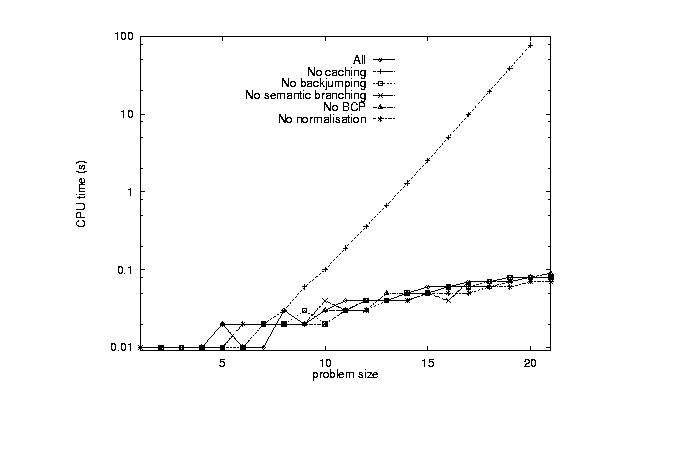
A problem set where caching is most effective.
K_dum non-valid problem set from Tableaux'98
(Note log scale for CPU time)
Effectiveness of Optimizations (cont'd)
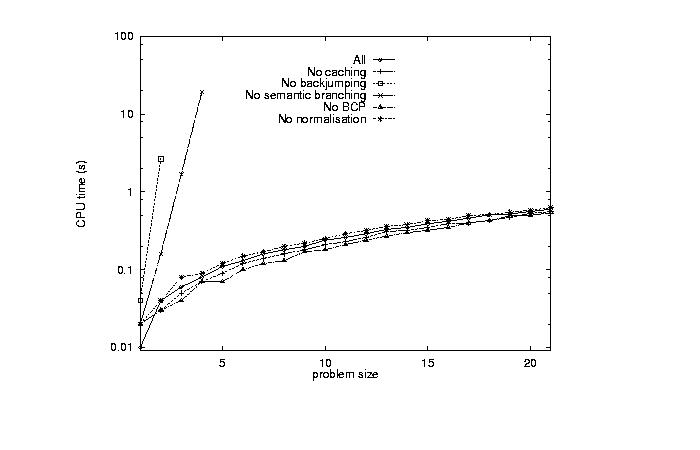
A problem set where backjumping and semantic branching are most effective.
S4_S5 valid problem set from Tableaux'98
(Note log scale for CPU time)
Effectiveness of Optimizations (cont'd)
| | FaCT | DLP |
KRIS | CRACK |
| Load | 6.03 | | 135.90 |
|
| Classify | 204.03 | |
>>400,000 | >>10,000 |
| Total | 210.91 | 69.56 |
>>400,000 | >>10,000 |
CPU time in seconds to process the GALEN Knowledge Base
Both KRIS and CRACK get about two-thirds of the way through and then get
"stuck" on the first hard subsumption problem.
Measuring the Improvements
How fast are the systems, and why? [Horrocks et al 2002]
- Measure on actual knowledge bases (GALEN, etc.)
- Only GALEN is suitable
- Other KBs are too easy for new systems
- Measure on hand-generated formulae (Tableaux'98)
- Lots of effort to build
- Too easy for new systems
- Measure on random modal formulae (as in SAT)
- Not really what we want
- Easy to generate
- Not easy to generate well
Ian Horrocks and Peter F. Patel-Schneider.
Evaluating
Optimised Decision Procedures for Propositional Modal Km Satisfiability.
Journal of Automated Reasoning, 28:2, February 2002, pp. 173–204.
Measuring Performance on Random Formulae
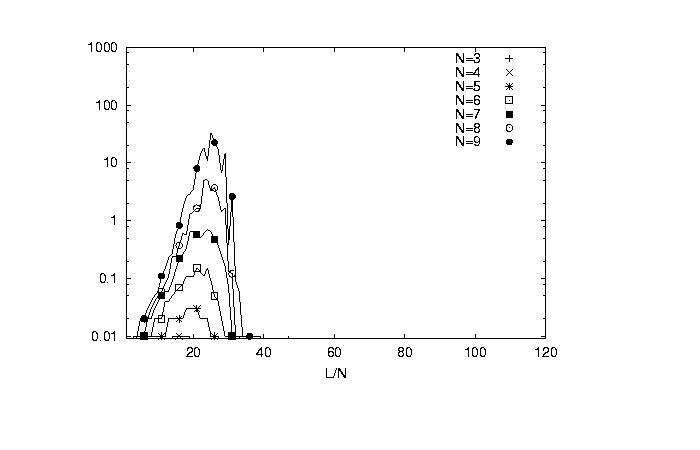
Randomly generated 3CNF◊ formulae in clause normal form.
Each clause has 3 disjuncts, either propositional literals or modal
clauses.
N is number of propositional variables.
L is number of top-level clauses.
Median solution time for formulae with modal depth 1 (previous generator)
Measuring Performance (Half-Dome Plot)
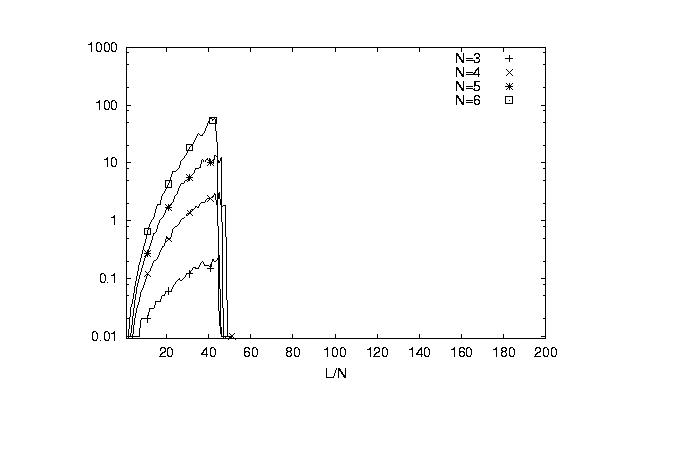
Why the "half-dome" shape?
The modal formulae become propositionally unsatisfiable:
(... ∨ ◊ &alpha ∨ ...) ∧
(... ∨ ¬ ◊ α ∨ ...) ∧ ...
Median solution time for formulae with modal depth 2 (previous generator)
Improving the Measuring
- Artifacts in random formulae
- Modal formulae that are propositionally
unsatisfiable
- Trivial clauses, with a subformula and its
negation
- Need to generate good formulae [Patel-Schneider and Sebastiani 2003]
- Cover the problem space
- Lots of control over generated formulae
- Suitable difficulty
- Need to be careful to
- not repeat propositional variables
- not repeat disjuncts in clauses (especially negated)
- not disturb the various probabilities
Peter F. Patel-Schneider and Roberto Sebastiani.
A
New General Method to Generate Random Modal Formulae for Testing Decision Procedures.
Journal of Artificial Intelligence Research, 18, 2003, pp. 351–389.
Improving the Measuring
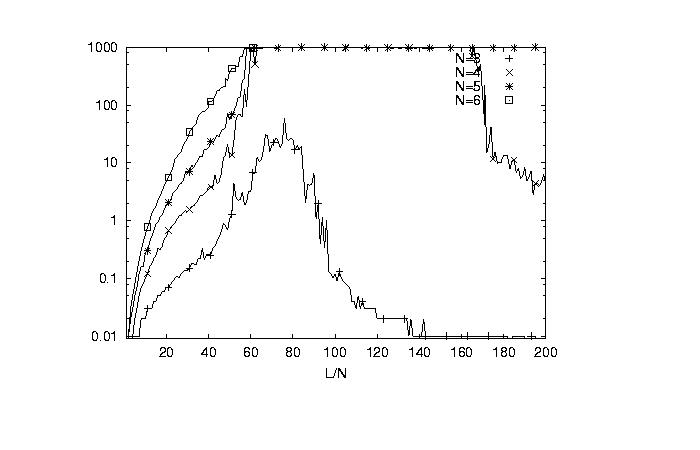
No artifacts.
Much harder than previous generator!
Median solution time for formulae with modal depth 2 (new generator)
Moving to the Semantic Web
- What is the World Wide Web?
- What is the Semantic Web?
- Why move to the Semantic Web?
- Because it's there!
- A good opportunity for use
- Interesting ontologies and knowledge bases
- What is Ontology? (Philosophy)
- What is an Ontology? (Artificial Intelligence)
- A way of saying what sorts of objects, etc., are to be
described
- Looks a lot like a collection of Description Logic concepts!
- To move to the Semantic Web, Description Logics have to live in the
Semantic Web
Initial Steps towards the Semantic Web
- OIL (Ontology Inference Layer/Language/Logic)
[Horrocks et al, 2001] [Fensel et al, 2001]
- An expressive Description Logic with a frame-like syntax
- Expressive power similar to that of FaCT, DLP, and RACER
- Syntax is an XML dialect
<class-def>
  <class name="tree" />
  <subclass-of>
    <class name="plant" />
  </subclass-of>
</class-def>
Ian Horrocks, Peter Patel-Schneider, Frank van Harmelen, and Dieter Fensel.
OIL: A Good Ontology Language for the Semantic Web.
WWW-2001, 2001.
Dieter Fensel, Ian Horrocks, Frank van Harmelen, Deborah L. McGuinness, and
Peter F. Patel-Schneider.
OIL:
An Ontology Infrastructure for the Semantic Web.
IEEE Intelligent Systems 16(2), 2001.
Living in the Semantic Web (circa 2001)
Resource Description Framework (RDF) circa 2001
- base language for the Semantic Web; similar to Semantic Networks
- all information is represented in subject-predicate-object
triples
- pretheoretic—no formal semantics
- some odd features—reification, higher-order
rdfs:Class rdf:type rdfs:Class .
ex:Person rdf:type rdfs:Class .
ex:John rdf:type ex:Person .
ex:Susan rdf:type ex:Person .
ex:John ex:friend ex:Susan .
Ora Lassila and Ralph R. Swick.
Resource Description
Framework (RDF) Model and Syntax Specification.
W3C Recommendation 22 February 1999.
Dan Brickley and R. V. Guha.
Resource Description
Framework (RDF) Schema Specification 1.0.
W3C Candidate Recommendation 27 March 2000.
The Semantic Web Vision
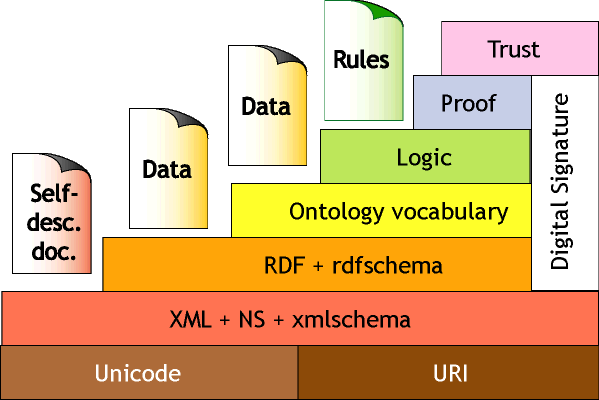
RDF is the base.
All other languages build on RDF and use its syntax.
The Semantic Web Tower (from Tim Berners-Lee)
DAML+OIL
DAML+OIL [Connolly et al 2001] [Horrocks et al 2002]
- Move OIL closer to the Semantic Web
- Use RDF syntax
- Not much semantics available to use!
- DAML+OIL provides its own model-theoretic semantics
- Uses RDF only as a syntax
ex:Wine rdf:type daml:Class .
ex:Wine rdfs:subClassOf _:c .
_:c rdf:type daml:Restriction .
_:c daml:onProperty ex:hasMaker .
_:c daml:toClass ex:Winery
Dan Connolly, Frank van Harmelen, Ian Horrocks, Deborah L. McGuinness,
Peter F. Patel-Schneider, and Lynn Andrea Stein.
DAML+OIL
(March 2001) Reference Description.
W3C Note 18 December 2001.
Ian Horrocks, Peter F. Patel-Schneider, and Frank van Harmelen.
Reviewing
the Design of DAML+OIL: An Ontology Language for the Semantic Web.
AAAI-2002, 2002.
Living in the Semantic Web (circa 2003)
- New basis for RDF
- Syntax more rigourously specified [Beckett 2003]
- Model-theoretic semantics [Hayes 2003]
- RDF is more like FOL than a Description Logic
- Each triple makes an assertion
- Entailment relation, similar to entailment in FOL
- To fit in the Semantic Web vision,
now need to fit into both syntax and semantics of RDF
- Can this be done, when Description Logic constructs have to
be encoded as triples?
Dave Beckett.
RDF/XML Syntax
Specification (Revised).
W3C Proposed Recommendation 15 December 2003.
Patrick Hayes.
RDF Semantics.
W3C Proposed Recommendation 15 December 2003.
Problems with Living in the Semantic Web (Part 1)
- RDF can treat classes as individuals
CorbansDryWhiteRiesling ∈ Wine
Wine ≤ PotableLiquid ∩ (=1 hasMaker) ∩ (∀ hasMaker Winery)
Wine ∈ owl:Class
owl:Class ≤ rdfs:Class
- Higher-order, but only in a sense
- This capability makes Description Logics undecidable
- Possible Solution: Define a subset of RDF and build on that
- Eliminate classes as individuals
- Forbid fiddling with RDF built-ins
Peter F. Patel-Schneider and Dieter Fensel.
Layering
the Semantic Web: Problems and Directions.
ISWC-2002.
Problems with Living in the Semantic Web (Part 2)
- Requiring only RDF syntax causes problems
- Don't get John ∈ Person implying
John ∈ Person ∪ Student
- Solution: Add "comprehension principles" (as in set theory)
- All lists exist everywhere
- All descriptions exist everywhere
Problems with Living in the Semantic Web (Part 3)
OWL (Web Ontology Language)
What is OWL?
- An ontology language
- Can represent information about classes and
properties
- Can also represent information about individuals
- A Description Logic
- Constructs are the standard Description Logic constructs
- More expressive than currently implemented Description Logics
- Part of the Semantic Web
- Has RDF/XML syntax
- Uses RDF model theory
- Uses much more of RDF than OIL, and more than DAML+OIL
Mike Dean, Guus Schreiber, Sean Bechhofer, Frank van Harmelen, Jim Hendler,
Ian Horrocks, Deborah L. McGuinness, Peter F. Patel-Schneider, and
Lynn Andrea Stein.
OWL Web Ontology
Language Reference.
W3C Proposed Recommendation 2003.
Ian Horrocks and Peter F. Patel-Schneider.
Reducing
OWL Entailment to Description Logic Satisfiability.
ISWC-2003.
The Semantic Web vs Description Logics
- Two syntaxes for OWL
- One Description Logic style, for ease of use
- One RDF/XML, to fit into Semantic Web
- Two semantics for OWL
- One Description Logic style, to get things right
- One RDF style, to fit into Semantic Web
- Three languages for OWL
- OWL Full, allows all of RDF, but is undecidable
- OWL DL, decidable fragment
- OWL Lite, even smaller fragment
Ian Horrocks, Peter F. Patel-Schneider, and Frank van Harmelen.
From
SHIQ and RDF to OWL: The Making of a Web Ontology Language.
Journal of Web Semantics, 2003.
OWL Knowledge Base Fragment (Revisited)
Taken from the OWL wine and
food ontologies.
<owl:Class rdf:ID="WhiteWine">
  <owl:intersectionOf rdf:parseType="Collection">
    <owl:Class rdf:about="#Wine" />
    <owl:Restriction>
      <owl:onProperty rdf:resource="#hasColor" />
      <owl:hasValue rdf:resource="#White" />
    </owl:Restriction>
  </owl:intersectionOf>
</owl:Class>
OWL Knowledge Base Fragment (Revisited)
Wine ≤ PotableLiquid ∩ (=1 hasMaker) ∩ (∀ hasMaker Winery)
∩ (≥ 1 madeFromGrape) ∩ (= 1 hasColor) ∩ ...
madeFromGrape ≤ Wine × WineGrape
hasColor ≤ Wine × WineColor
WineColor = { White, Rose, Red }
White ≠ Rose White ≠ Red Rose ≠ Red
WineDescriptor = WineTaste ∪ WineColor
WhiteWine = Wine ∩ ( hasColor : White )
Riesling = Wine ∩ (madeFromGrape : RieslingGrape ) ∩
(≤ 1 madeFromGrape)
Riesling ≤ hasColor : White
CorbansDryWhiteRiesling ∈ Riesling ∩ (hasMaker : Corbans) ∩ ...
What Can OWL Do?
Given an Ontology:
- Determine implicit subsumption relationships between classes
- Determine where a new description/individual fits
- CorbansDryWhiteRiesling ∈ WhiteWine
- Determine when a description is incoherent
- Determine when an ontology is inconsistent
- CorbansRedRiesling ∈ Riesling ∩ (hasColor : Red)
The End?
- Not really
- What needs to be done?
- Inference
- Characterizing inference in OWL-DL (in progress)
- Optimizations for OWL
- Systems
- Real implemented systems for OWL
- Evaluating OWL systems
- Surround
- Explanation, Query, Learning, ...
- Usage
A Differing Vision of The Semantic Web
- Vision based on single RDF-based syntax and semantics causes severe
problems
- So, allow for different syntaxes
- One for RDF and RDFS
- One for an ontology language
- One for rules
- One for XML data
- One for ...
- And tie them all together with semantics
- Different semantics should be compatible
- Semantics for the ontology language would also provide
compatible semantics for (part of) the RDF syntax
Peter Patel-Schneider and Jerome Simeon.
The
Yin/Yang Web: A Unified Model for XML Syntax and RDF Semantics.
IEEE TKDE 15(3), 2003, pages 797–812.
Ian Horrocks and Peter F. Patel-Schneider.
Three
Theses of Knowledge Representation in the Semantic Web.
The Twelfth International World Wide Web Conference.
Budapest, Hungary, May 2003, ACM Press, pp. 39–47.
My Future Research (Proposed)
- Build system for OWL
- Characterize inference in OWL
- Optimize inference algorithm for OWL
- Evaluate performance (on real data, hopefully)
- Investigate alternative computing models for inference
- Lots of opportunities for parallelism
- Fine-grained - subset testing
- Medium-grained - and/or searching
- My provers are mostly-functional - does this help in
building parallel hardware?
- Integrate reasoning and learning into a cognitive system
- Learn OWL concepts (probably many concepts)
- Use learned concepts in applications
- Retain learned concepts that were useful, discard the rest
- Which application—web service composition???