System Integration
In a heavily parameterized system like this, one very quickly ends up
with a large number of modules and dependencies making it very
easy to mix things up in the wrong way. 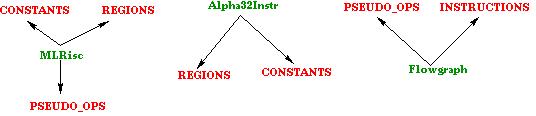
For example, MLRisc is parameterised over pseudo-ops,
constants, and regions. An instruction set must be parameterized
over constants so that instructions that carry immediate operands
can also carry these abstract constants. Instructions must also be
parameterized over regions so that memory operations can be
appropriately annotated. Finally, the flowgraph module must be
parameterized over instructions it carries in basic blocks and
pseudo-ops that describe data layout and alignment constraints.
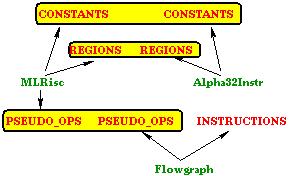
In integrating a system that involves these modules, it must be the
case that they were created with the same base modules. That is to
say the pseudo-ops in flowgraphs must be the same abstraction that
was used to define the MLRisc intermediate
representation. Alternatively, we want sharing
constraints that assert that identity of modules used to
specialize other modules. In Standard ML, this is a complete
non-issue. A single line that says exactly that is all that is
needed to maintain consistency, and the module system does the rest
to ensure that the final system is built correctly.
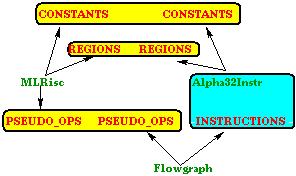
In certain cases one wants to write a specific module for a
particular architecture. For instance it may be desirable to collapse
trap barriers on the DEC Alpha where it is legal to do so. The
INSTRUCTIONS interface is abstract with no built-in knowledge of
trap barriers as not all architectures have them.
Further the DEC Alpha has fairly unique trap barrier semantics,
that one may want to write an optimization module specific and
dedicated to the Alpha instruction set and architecture, and forget
about writing anything generic. In this case, the Standard ML module
system allows one to say that a specific abstraction actually is or
matches a more detailed interface. That is to say the INSTRUCTION
interface is really the DEC Alpha instruction set.
Lal George
Last modified: Thu Jun 25 23:00:04 EDT 1998