Problem Statement
Writing a
native code generator for any language is a signifcant
investment especially for todays modern processors with a high
degree of instruction level parallelism. The algorithms that must
be used to generate high quality code are complex, sometimes quite
delicate, and require substantial infrastructure.
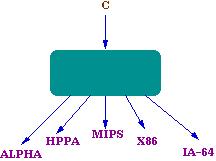 A specific architecture has a
relatively short life time in relation to the time taken to build
the code generator, and one quickly needs the ability to retarget
to new versions of the architecture, or to different target
architectures. This is by no means an open problem. There are many
compilers today that target multiple architectures, however the
quality of code varies. For example, lcc by Chris Fraser and David Hansen does
no back end optimizations; gcc from
the Free Software Foundation does extensive peephole and simple
data flow optimizations, and falls short on advanced superscalar
optimizations; and finally the impact
compiler done by the Impact group at the
University of Illinois specializes in more advanced superscalar
and predicated architectures.
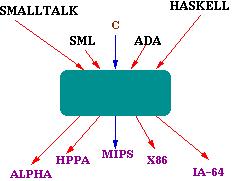 Assuming
the retargeting issue is solved, one would like to use all the
developed infrastructure for multiple source languages. This
problem is far from solved; even though gcc has been used
for multiple languages like Ada, Pascal, and Modula III, each of
these have similiar execution models or were forced to adopt C
conventions. gcc cannot be used directly for languages
such as Lisp, Smalltalk, Haskell, or ML that have radically
different execution models and special requirements to support
advanced language features.
Lal George
Last modified: Tue Apr 28 11:58:41 EDT 1998