Consider the problem of designing a system to recognize characters, faces, or to predict the next day in the stock market, or the weather. In these cases, since the rules defining the problem may not be well-defined or may change in time, explicit programming may not be applicable. Given input-output examples of such a problem, learning-from-examples can be used to find a solution.
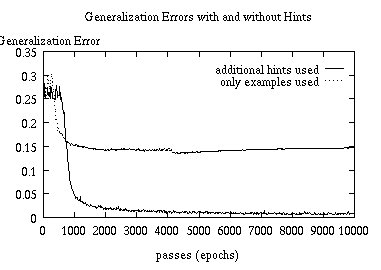
Figure 1. Generalization improves when additional hints are used.
When not only input-output examples, but also some rules about the unknown function are available, these can be incorporated in learning. Learning-from-hints [1] allows expressing rules about a function as examples, and using a learning-from-examples system to learn these rules. Figure 1 shows the effect of hints on generalization error, which improves when additional hints are used.
Hints affect generalization. When more than one hint is available, how much each should be taught becomes an issue. The scheduling problem [2] is the problem of how much to teach each hint. The goal of learning is to achieve minimum generalization error. Therefore, if the generalization error can be estimated as a function of hint errors, the resulting estimate can be used to solve the scheduling problem.
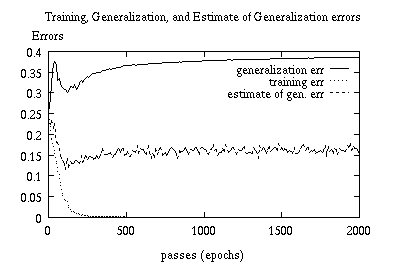
Figure 2. Generalization error is closer to its noise estimate than it is to training error.
In the case of invariance hints, such an estimate exists [3] . In this approach the generalization error is approximated as the sum of mean and variance of a noise function, which are computed in terms of hint errors. Figure 2 depicts the plot of the training, generalization and estimate of generalization error, for a training session using the function examples only. As seen in the figure, the estimate of generalization error follows it better than the training error, which is the only estimate of generalization error in the absence of additional hints.
Unfortunately, the above estimate can only be used with invariance hints, so our research continues to find estimates of generalization error for any type of hints.
The experiments above were performed by a program (train) written in C. The program can be used to train feed-forward neural networks using different hints, schedules, and optimization methods.