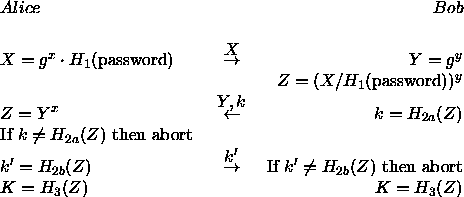
We start with a simplified version of the PAK protocol. The idea is to do an authenticated Diffie-Hellman key exchange, but entangle a hash of the password with the first Diffie-Hellman value sent by Alice.
Details:
 of size q
where q is a 160-bit prime that divides p-1.
(This means most exponents only need to be 160-bits
instead of 1024 bits.)
 will be almost uniformly random in .
The intuitive reason this protocol works is that Bob can only guess one password at a time, since Bob sends his authentication value (k) first, while Alice can only guess one password at a time since she has entangled her value X with the password, and cannot compute a valid Z for any other password (by the hardness of the Diffie-Hellman problem).
However, there are some questions you may ask, like:
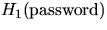 is not in the subgroup generated
by g? Doesn't that lead to subgroup confinement attacks?
To solve these problems, we must enhance the protocol, as shown in the next section.