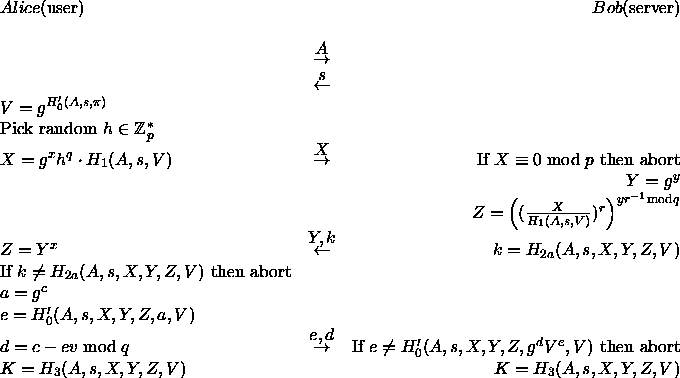
Finally we present the protocol used in the PAK distribution that is resilient to server compromise. That is, when a server's password file is compromised, the passwords are still hidden, and one cannot use the compromised password file to successfully impersonate a user (at least not without having to run a dictionary attack on the password file).
We do this by having the server store a salt value s and a password verifier
for a user A
of the form V=gv, where  .
Then the PAK-RY protocol is run to determine that both
the user and server know V, and additionally, we have
the user prove that he knows the discrete log of V (i.e., v).
This is done using a non-interactive Schnorr proof.
We call this the PAK-RY protocol.
As stated above, this is the protocol used in the PAK distribution (PAKtelnet and PAKftp). It is slightly different than the PAK-RY protocol from the paper (coming soon) in that the salt value replaces the identity of the server. This could only affect a user in the following situation: The user uses the same password on two servers B and B', but somehow does not reveal the password to B'. However B' is allowed to set the salt, and sets it to be the same as the salt value for B. Then the user has the same V value for B and B', thus allowing B' to impersonate B.
However, it seems most likely that a user will either
If the bad situation we described above is possible, then the design of the protocol must be changed back to include the server identity in the computation of the password verifier.