
John M. Chambers Award for Outstanding Student Work
in Software for Statistics
On Saturday May 15, the Association for Computing Machinery (ACM) presented its prestigious Software System Award to researcher John Chambers of Bell Labs. The award was presented for the design of the S System for statistical computing, which the ACM said has ``forever altered how people analyze, visualize, and manipulate data . . S is an elegant, widely accepted, and enduring software system, with conceptual integrity, thanks to the insight, taste, and effort of John Chambers.'' And in more good news for statistical computing, Chambers announced plans to turn over his \$10,000 award to the American Statistical Association to endow a new prize that will recognize outstanding student work in software for statistics. This is the first time in its 17-year history that the Software System Award has been given for data analysis software, and the first time it has been given to a statistician. Beginning with the UNIX* System - created in 1969 by Bell Labs researchers Dennis Ritchie and Ken Thompson - the Software System Award has recognized ideas and developments that have had a major, lasting impact on computing, such as TCP/IP and the World Wide Web.
The first versions of S in the 1970s pioneered the use of data visualization and interactive statistical computing. Subsequent versions provided richly enhanced modeling capability, and user extensibility, based on its functional object-based approach.
Still more recent versions provide a powerful class/method structure, new techniques to deal with large objects, extended interfaces to other languages and files, object-based documentation compatible with HTML, and powerful interactive programming techniques. The commercial version, S-Plus, is used across many disciplines where analysts must struggle with creative ways to manage and extract useful information from data. More information about S is available at the Bell Lab's web site .
John Chambers is one of the researchers pursuing a new joint project,
Omega , aimed at the next generation of statistical software. In this project, emphasis is on Java and distributed computing, with the goal of a wide range of new software in open source, benefiting and involving the whole statistical computing community. More about Omega and its activities can be found on the project's web site.Looking toward the future in another way, Chambers donated the prize money from his Software System Award - all $10,000 of it - to the ASA, to endow a prize for the best student software written to support the computing used in statistics.
The purpose of the prize, Chambers said, ``is to recognize contributions in the design and implementation of software that has value for the statistical community, and to raise awareness in that community of the importance of good software to those involved in statistical applications and research.'' In particular, Chambers hopes the existence of the prize will foster greater recognition that software design is a key component of statistical research, deserving recognition on the same level as mathematical theory and other essential elements.
Statistical software created by undergraduate or graduate students in any field will be eligible for the prize. The prize will be administered by the Statistical Computing section of the ASA. Details of the prize will appear in future issues of the Newsletter and Amstat News.
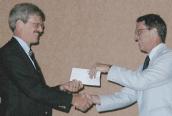
John Chambers (right) hands over the ACM prize to 1999 Computing Section Chair Jim Rosenberger (left). The money will be used to establish an award supporting student research in statistical computing.
