May 09; Firenze
At a first impression, Florence is indeed a dazzlingly beautiful city. Helped
in this case by the hotel, both its site (views of the city to dream of) and
its own historic interest and beauty.
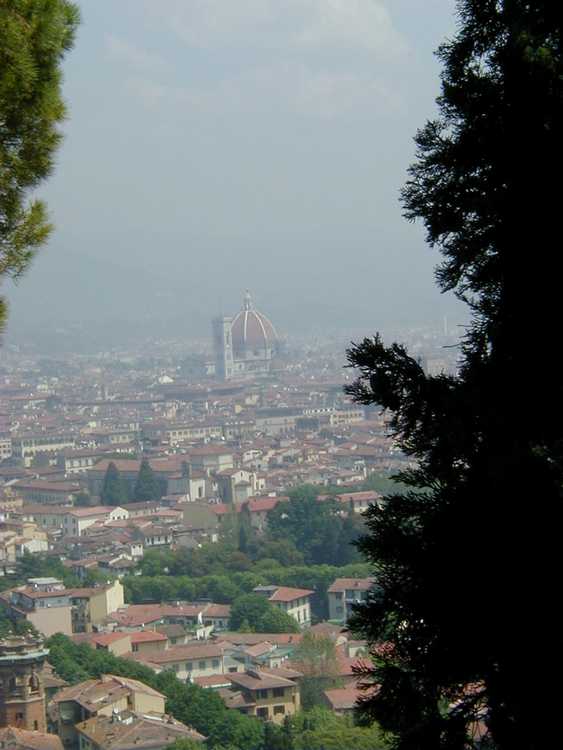
 This may look like one of the standard glossy cocktail-table-book photos of the Duomo, but in fact its taken
from the window of my hotel room (or suite). Later in
the afternoon after checking in, I walked down to the
cathedral and, yes, the dome is really as beautiful and as
fascinating artistically as all the hype suggests. When
my first view of Florence from the hotel was this, small
wonder I was bowled over! And, from other windows,
essentially all the famous Florence views appear.
(More to fill in later: garden, visit to Duomo, dogs, cat, singing street
people, happy families,...)
(Entered May 10: I stopped above as I found my eyelids closing! Seemed
a better idea to get back outside in the sunshine, and resume data entry
later. Surprisingly I did revive after the meal described below, and even
tried to get to a concert of baroque music (by a bunch of unknowns). But
the meal was so good that I had only 10 minutes or so to get to the
church where it was advertized. That might still have been OK except that
my memory of the location was a little vague, and it turned out that the
sign was just an ad for the concert which was in fact at another church.
Oh, well.
So, anyway, the day up to then. Oh, could I love Italy, or at least
Florence! The flight over was, relatively speaking, fine; that is, no delays,
they did not lose my luggage. But it was just a grind. The drive to JFK
was medium slow because of a couple of traffic jams, the Sabena service
was not that great, the plane to Florence from Brussels was noisy and
crowded, etc. The usual story. So, I was saying to myself, “Why am I
doing this?” But Florence! Just stepping from the plane, the air was
beautiful, the sun was warm and gentle, the airport (rather tiny) kind of
friendly. It's gone on that way, for the last day and a
half.
[Photos]
And the hotel! Never in all our trips have we stayed in a hotel that is such
a combination of an artwork in itself and a location to dream of! Words
and pictures don't really do it justice. It's a renaissance era villa, with a
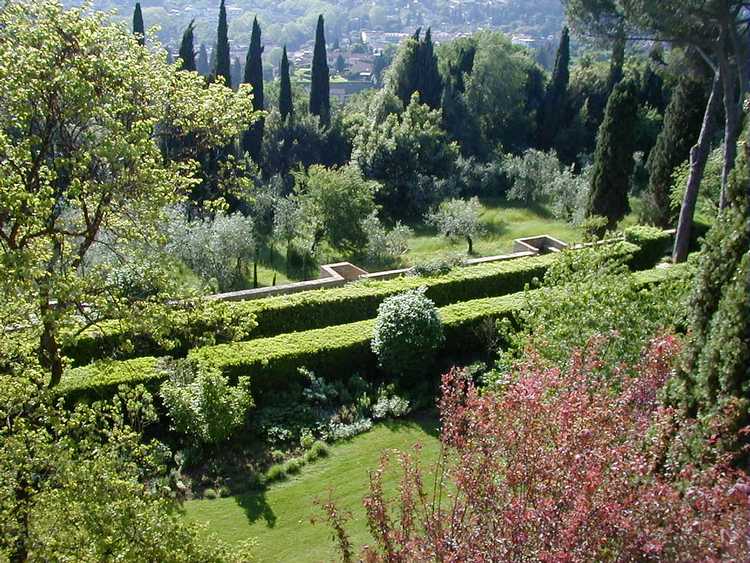
13th century tower, not many rooms to occupy, but a huge garden on the
hillside, and a number of salons, terraces and other spaces worthy of a
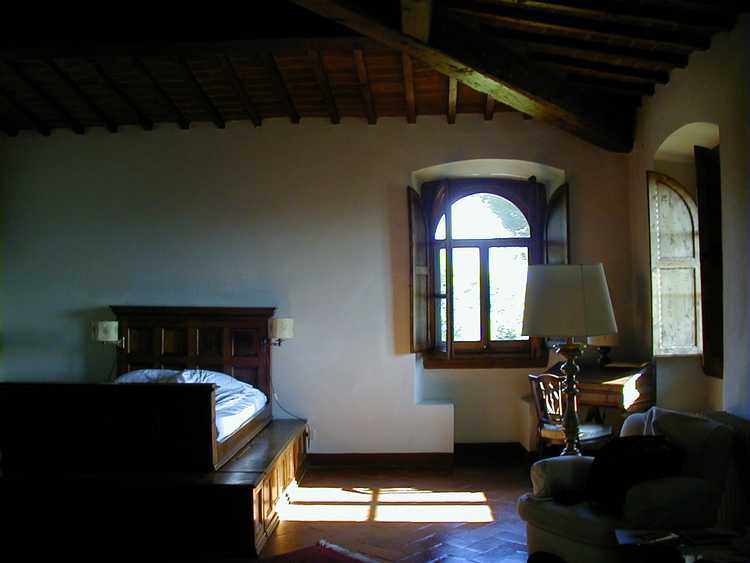
grand villa, or of a museum of the Italian renaissance. My room is on a
corner of the 2nd floor (European sense) with the ceiling being the beamed
roof of the villa, and with a perfect view of the skyline of Florence far
below. The climb up is serious (I did it once yesterday and since have
taken taxis, so far.) As a result you hear pretty much only the songs of
the hundreds of birds nesting in the trees of the garden. With windows
open at both ends, as I have now, a heavenly breeze blows through,
banishing memories of the exhausts of the streets below (actually Florence
is only medium on the European pollution scale).
[Photos]
[More Photos]
[Garden Photos]
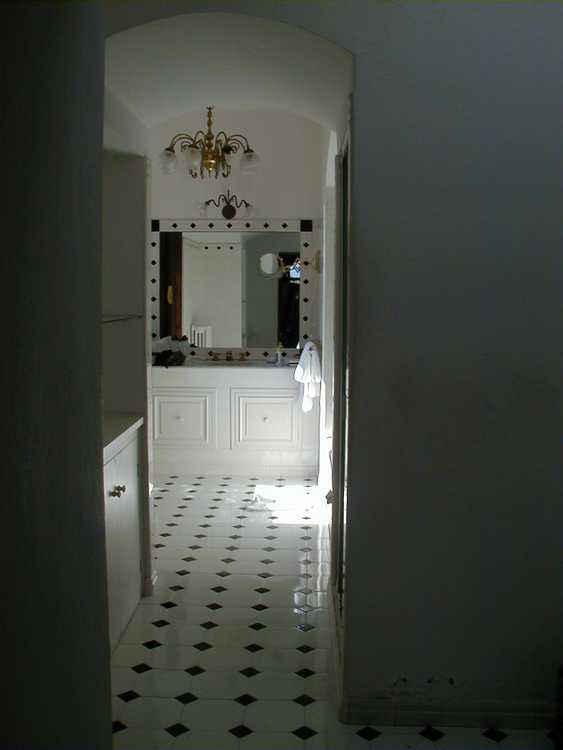
The bath area is a suite in itself! A rather exotic
shower stall, complete with body shower but a bit
tricky to regulate. A toilet room with separate
washstand and bidet (which
reminds me of a conversation with
Mark and Bin Yu, where I tried to
convince Mark of the civilized
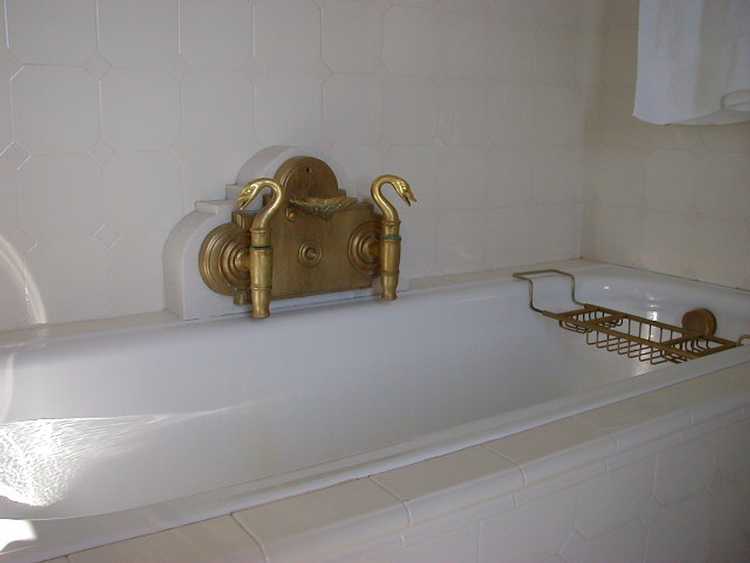
nature of the appliance!). A large bath, and a separate
alcove for washing and shaving.
The pedestal bed would be cozy for two (the room is
listed as a double) and climbing up and down is
amusing. But it's quite comfortable. In general, the
wood furniture seems fairly old, not especially fancy but just nice. The
ceiling, as mentioned, is all wood beams with brick in between. At its
lowest, over the bed, it's about 10 feet, and at its highest at the door
about 15 feet. The floor is also brick, glazed over, in the living room, and
white ceramic tile in the bath suite.
Why is this not one of the most famous hotels in the world? Well,
apparently it is among certain cognoscenti. But also, its facilities are not
quite the ultimate. For example , neither TV nor radio. Somehow, that
seems just right to me. You should listen to the birds instead. Also, no
restaurant. And some of the features are more picturesque than practical;
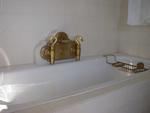
such as the wonderful brass swan spigots for the bath. These look great
but the cold-water swan has rusted and doesn't turn, so getting the bath
temperature you want is a matter of guessing how long the hot water will
take to turn really hot, and shutting the drain at the right time.
Anyway, if ever I should return to Florence, I can't right now see how I
could stay at any other hotel..
The only real problem is tearing oneself away to go to Florence. After my
jaw stopped dropping when I arrived, I walked downhill (that direction is
easy!) and on to the center of town. Surprisingly, it's not that far, despite
the feeling of overlooking the city. Following a policy that has worked
many times, I reduced the effect of clock time dislocation by lots of
walking in the sunshine, followed by a meal at the local dinnertime. So I
have already seen the outside of much of Florence.
It is perhaps the most strikingly, artistically beautiful city, overall, that I
have ever seen. Not to say it surpasses Paris or London in what it
contains. But Florence is concentrated on a relatively narrow time span, it
has a unity of appearance that can draw your imagination back in time, it
has kept out more of the distracting modernizations than other cities, and
most of all, it just contains more masterpieces of art and architecture than
any comparable area I have ever seen.
On the 9th I did the outside of the Duomo and the Baptistry, marvelous
marble and an incredible east wall in the Duomo. And the famous bronze
doors of the Baptistry, worth a visit to the city all on
their own. Plus half a dozen other squares and several
churches.
I'm also taken with the Italians as people, so far as I've
watched and encountered them. They seem to take life
with both hands and enter fully into each moment. There is probably a
good deal of role-playing in it, particularly with the men. But it feels good
to watch them and talk to them. Quite a contrast with my previous trip in
March to Vienna and (especially) Zurich. The stereotype of the northern or
Protestant temperament vs the Mediterranean has some real basis. Just a
flash view: As I was walking to the restaurant, a man came home to his
apartment, opened the door and called out–his son or daughter aged
about 4 ran down the hall laughing to greet him.
The Florentines seem to be real dog people, too. Many friendly dogs
around. Plus the hotel has a resident (garden) cat that acts like a dog!
When I was wandering around the garden, it came by for a rub against my
leg, and then hopped up next to me on the garden bench, just curling up
quietly the way a dog would.)
Dinner: “Alla Vecchia Bettola” Recommended by the hotel clerk (and I had
noticed it on my walk). At the bottom of the hill from the hotel. It
opened at 7:30 (although in theory at 7); by 8 it was mostly full (it holds
about 60 people), by 8:30 it was jammed. Some (other) tourists, but
mostly local people. Just what you would expect a neighborhood
restaurant in Italy to be: fresh, well prepared local dishes, nothing really
fancy but all of it very good. And the spirit of sheer pleasure (and a fair
amount of bull from the head waiter to all the customers) made it clear
that people come to really enjoy their meal.
Antipasto: Prosciuto & Melone (lovely fresh but sweet melon; ham strongly
smoked but not too salty)
Pasto: Penne (!) Had to try it. Well, for starters, the Italian penne is half
the diameter of the American, and it cooks up tender. Tomato sauce with
a little meat and a bit spicy.
Secondi: Roast duck with (a little) sausage. Nothing fancy, but good and
not too fatty (In my opinion, though, a little overcooked.)
With that a mixed salad. In this restaurant, you mix your own dressing.
Fine by me.
House wine. Almost everybody had that, although the couple next to me
ordered what looked like a Chianti Classico. But the house wine was fine.
To say the least not subtle, but fun just like the rest of the meal. It comes
in big bottles that the waiter just opens and leaves there. You drink what
you want, and presumably the next customer continues on, with the
supply being refilled as needed.
Mineral water: Palina (or Patina, couldn't distinguish on the bottle) seems
to be the standard restaurant water so far, sparkling or still. The hotel has
San Benedetto in the room.
Lots of other interesting dishes went by, so I'll try to eat there again.
I had actually planned to go to a concert tonight, though whether I would
have stayed awake is a question. The concert started at 9:15, and was a
fair walk away, so it was questionable if I would have made it on time
anyway, since dinner ran to about 9. But it didn't matter, since I had the
wrong church; the notice was on one church but the concert was at
another one! A baroque recital, interesting music by an unknown (to me)
countertenor. Not likely to have been great anyway, but sorry to have
missed it. Still, I would have been sorrier to miss dinner.
May 10; Firenze
Woke up with the dawn (and the birds!), but marveled at the dawn mists
over the city, and then went back to sleep until after 8am! Had breakfast
on the outdoor terrace and met a charming couple from Denver. Turned
out they are starting on a bike tour of Tuscany the same day I start the
walking tour.
Today was to have been the day for the Ufizzi museum. Well, turns out
the tourist pressure is such that you don't just walk in. The choice is to
stand in a long, long line for immediate entry, or to buy an advance ticket.
So I bought a ticket for tomorrow and went on to the Pitti Palace,
Florence's “second” art museum. Meaning of course that it has a collection
that museums in any other city in the world would probably kill for. The
Pitti itself would take a week to absorb, so I decided to concentrate on two
painters, Titian and Rafael, roughly contemporary and both famous for
portraits. And, not by coincidence, the Pitti has about the world's finest
collection of Rafael portraits, and nearly so for Titian. The Pitti is itself an
amazing building. I tried to concentrate though on the two painters,
walking back and forth to really absorb what they had to say. I've loved
Titian from afar (and from other museums) especially for his mastery of
color and texture. I must say today's saturation in him has somewhat
changed my view. All that mastery is certainly there, but with a darkness
both technical and spiritual that grows in his older years, until his late
portraits are a mass of black with the touches of costume and, especially,
the faces shining out, but still with a haunted look, and often a touch of
cruelty in the male portraits. Rafael on the other hand, although he can
paint darkly too, seems to retain a happier outlook, along with his famous
eye for detail, much contrasted to Titian's later, very impressionistic style.
Had a modest lunch on Via S. Augistino: Minestrone di verdura and a
salad, at an outdoor table (better the street noise than the musack inside).
Nice.
Bought two tickets for the May Festival.. Handel's Tamurlano tonight, and
the Verdi Requiem on the 20th.
Back to the hotel to relax for a bit before dinner and
opera. Took a more serious turn through the hotel's
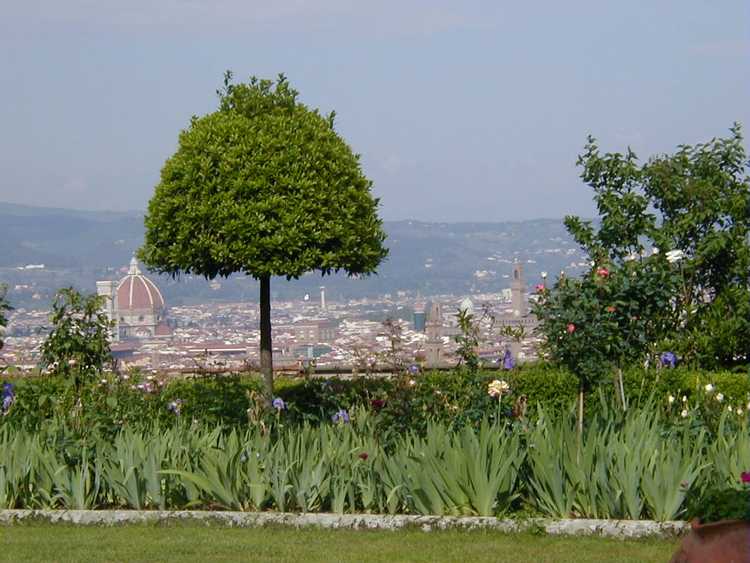
garden. This is amazing, almost unbelievable for its
extent, quality, and level of care. The view of the
city from one end of the garden shows just the
tiniest part of the plantings (and also the fantastic
perspective on Florence from the hotel–the Duomo
and the Campanile are on the left of the tree, with the Pallazzio Vecchio on
the right.) But the garden has several fabulous areas. An artificial stream,
a rose arbor, a series of ponds.
A quick meal at a restaurant a few blocks from the Teatro Pergola: Zuppe
di Pesca, Insalata Mixta, a 1/4 bottle of Prosecca (Spumante). Italian
discussion with the waiters about whether there was time to have the meal
before the opera. Somewhat of a strain on my Italian, until the word
“tempo” came up–then they understood and assured me there was no
problem. Well, that was sort of true, I did get to the theater on time, but
only after some serious pushing to get the bill. (Comment: much more
than the Viennese or Swiss on recent experience, the Italians will happily
try to talk with you in Italian if you start, even if their English might be
better. It's partly they don't get so impatient with you, partly that their
English may not be better. On the whole I like this attitude.)
So, the opera. Tamurlano is one of Handel's less well-known operas, both
generally and to me. It has some lovely music, including a gorgeous duet
for Areste and Adrionico. It does have two disadvantages in practice: first,
it's long (just four hours in this production) and static (really nothing
happens until right near the end when one character commits suicide and
Tamurlano relents and turns into a good guy. End of opera.) Second, it
was written for two famous castrati of the time, presenting an unsolvable
casting problem today.
The performance, part of the Florence May Festival, was generally of high
musical quality, without being really exceptional when held to the highest
standards. All the singers were musically fine, the intonation was good,
they showed a sense of style. The Festival orchestra, which in the old days
had a pretty bad reputation, was also good without being outstanding. The
style was the now almost standard approach of modern instruments with a
few additions (here, theorbo added to the continuo and recorders
alternating with modern flutes) and with attention to period performance
practice (chamber size orchestra (6-6-3-3-1 strings) and little vibrato).
That the strings were steel not gut I can be sure since I was sitting on the
far right of the first row! This turned out to be a fabulous seat, since there
was a stair on that side down from the stage. All the characters at some
time paused there to sing an exit aria directly at me, about 15 feet away!
Basically I enjoyed the opera and the performance very much. Now, as to
those two problems. They dealt with the casting problem by having two
mezzos in the castrati roles. They dealt with the long-and-static problem
by, well, being creative in the staging. See the program book for pictures.
It was just as stupid as it looks in the pictures, and then some. Too many
details to mention. But there was a non-singing chorus who walked around
making gestures, which the singers had to imitate at times as well. These
seem to have been created by a branch of the Monty Python “Department
of Silly Walks”, except slower. In the final act, Tamurlano and Andronico
(the two original castrati characters) were dressed up to look like a painting
of the two original famous singers. This was actually a neat touch, except
it had nothing to do with the costuming as previously designed. And there
were various pointless props, like a procession of little blue elephants, later
replaced by one big blue (stuffed) elephant on which the princess had to
ride. And so on.
The strongest singer in my opinion was the bass, Umberto Chiummo,
followed by Laura Polverelli, soprano. Unfortunately, they had the two
smallest of the principal roles, but they showed some fire and spirit. The
rest of the cast sang correctly enough, but blandly. Not coincidentally,
most of them were non-Italian, as was the conductor, Ivor Newton, new to
me and only OK. In summary: Nothing in the league of my Don Giovanni in
Zurich, but quite enjoyable.
Back to the hotel around 1 am. Well, not even Florence escapes. There
was an outdoor rock concert somewhere in the Florence area, still going on
and still audible even in Belosguardo (just vaguely in the background but
enough to interfere with getting to sleep).
May 11; Firenze
Two major sites today: in the morning the Basilica of San Lorenzo, in the
afternoon the Ufizzi delayed from May 9.
San Lorenzo is the Medici “family chapel” designed by Bruneleschi. Of
course for this particular family , the result is a cathedral-sized building
slightly smaller (maybe) than St. Paul's. More to the point, it was the
revolution in church architecture that marks the transition from Gothic to
Renaissance and later Baroque design. Bruneleschi was in a sense to
architecture what Copernicus was to science: the definitive break with the
medieval past. And on top of all that, the building and its contents are
breathtakingly beautiful. Again, one just walks around awestruck. The
basic design–the columns, the ceiling (both revolutionary in themselves and
powerfully, simply, cleanly beautiful–is wonderful and truly integrated,
unlike even many of the finest churches. Saint Paul's comes as an analog,
and it certainly could not have existed without San Lorenzo. It's also two
centuries in the future!
Many wonderful artworks are included. It helps of course if you have
people like Donatello as colleagues: his brass reliefs for the two pulpits are
staggering masterpieces on their own. Only in Florence, only from the
Medici. And in the case of San Lorenzo, not even something that can really
be conveyed by photos or loaned out to museums.
Couple of quick bites to eat before and after the Ufizzi., nothing to mention.
Florence seems to work out for me. Where in other cities I seem to be
able to get lost even when I think I know where I'm going, in Florence
most of the time I will look at my map and realize that I'm on the right
basic track, but maybe just now need to make a turn. Not always, but
often.
Then too, after San Lorenzo the noise and crowds were really getting to
me. Not enough time to get back to the hotel. I noticed a Garden on the
map. Turned out to be the Botanical Gardens attached to the University.
Also turned out you could get in, for a small fee (6000 lire) once you got
the attention of the gate house (not an easy task). But once done, it
turned out to be a heavenly oasis away from the surrounding city. And
practically deserted.
Finally Ufizzi. And, alas, the first major disappointment. Huge crowds, but
I expected that, and it turned out that the largest crowds were not in the
rooms I was set on; namely, the Boticelli and Da Vinci rooms. But they
have done one thing I cannot forgive and that utterly spoils paintings for
me. Nearly all the really important paintings are behind glass, for security
reasons I assume. This totally prevents any intimate contact, especially in
matters of color and brush technique. Not to mention, it becomes
impossible to see details at all except by maneuvering around for each spot
on the painting to eliminate glare. To see how the glass destroys the
painting one only has to compare with the (excellent) offical guide. The
catalog and actual colors match extremely well if the painting has no glass
in front. If there is glass, the catalog colors are uniformly brighter and
more exciting than the “real” thing. Disgusting!
Back to La Vecchia for dinner–they're friendly and the food is good.
Tonight I start with Funghi, sauteed in olive oil (what else?) but served
room temperature, since they're cooked ahead. Mushrooms ok, olive oil
delicious. Then Ribollita (? not in my Italian menu book), listed as a soup
but really various beans in a light sauce. It looked daunting, but turned out
not to be as heavy as it seemed. Vitello al forno (i.e., roast veal) ok, but
not that tender. Salad. Then gelato with strawberries. Lovely ice cream.
At first I was excited by the strawberries, since they looked very much like
fraises des bois or American wild strawberries. And it is the right season.
They were interesting, but tasted a bit off (or more precisely not really
fresh-picked). Possibly just the difference in varieties.
After dinner I walked back up the hill (SLOWLY) enjoying the beautiful
night. (Also testing out my hiking boots, which have been inactive while I
was in the museums in Florence.) Tomorrow, real walking begins.
May 12; Firenze to Sienna
Woke up feeling a little unsettled in the stomach–maybe should have
avoided those strawberries. But a yoghurt with breakfast and some rest
seemed to help; I cancelled tentative plans to walk back to Florence in the
am, and instead just packed, rested and took some more pictures of the
amazing garden here.
Taxi into town after noon to meet the hiking party. The guides are both
extermely interesting. Angelica Turi is a Tuscan of long descent, who
works on various artistic endeavors, but mainly as a restorer of paintings
and, especially, parchment documents. She attributes her choice of
profession in part to having been born in 1966, the year of a disastrous
flood in Florence, that damaged countless numbers of priceless art works
and documents. So in a way her life is being partly spent in repairing the
damage.
Verena von Zobelitz, as the name suggests, is German. She has been living
in Rome for 4 years and works in various theatrical and film related
activities in Rome, chiefly doing post-production editing for Italian films.
She has apparently worked on some well-known Italian films, but my
knowledge of the subject is too limited to judge. She hopes next to be
working on a film on the life of the famous early Renaissance artist Filippo
Lippi, to be made by a well-known (though, al as, unknown to me) Italian
producer. She likes to do the tours, she says, because she spent 10 years
in the U.S., mainly in New York, and it helps her keep in touch with
the U.S.
It's very luxurious to have them
both for so small a group. In addition there is a bus driver (Sauro) for the
week, and quite a pleasant bus that seats about 3 times our group's size.
We took a lovely walk in the hills above Florence, ending up at a
magnificent Romanesque church, San Miniato.
[Photos]
The hotel in Sienna is some contrast to Belosguardo! The entire
room+bath here would fit easily inside the bath suite there. But at least
the room is off the street and should be fairly quiet. We're meeting shortly
for “cocktails” and a review of plans. I will take the computer down to
show them today's pictures. Then dinner at a local restaurant.
One serendipity is that everybody seems to be enthusiastic about sampling
good wines. We will work out details about how, but prospects for food
and wine seem promising.
Dinner at Restorante Mugolone: Antipasto (bruschettti, chicken livers;
olives; ...) Pasta: Tagliatelli with beef, prorcini and tomato (fabulous!);
roast pork with spinach and roasted potatoes; peccorino cheese (ordered
specially to go with the 97 wine); cake with pignolias/chocalate/creme
anglaise topping. Wines: standard a 98 local Chianti Classico (very good,
soft, fruity–not a traveller or a keeper I'd guess). I ordered specially 97
Castello di Ama (65000 lire, a steal) just simply superb. Finesse, rich herbal
tastes but no hotness. Very dry but still smooth, improving continually in
the glass throughout the meal.
May 13; Sienna
Woke up early (~5:30) and went for a walk in town around 6. At 6:30, I
was at one of the many churches, Santa Maria de Servi, when suddenly a
loud, deep bell started to ring, echoing over the city. Aside from the bell
there was hardly a sound. The effect was magical. Only later on did I find
out that I had witnessed a rare event: The bell was the great bell on the
municipal tower in the Piazzo del Campo. It dates to the 13th century and
is only rung to summon the citizens, originally for a meeting or an
emergency. Nowadays it is only used for two things. Most commonly, it
announces the begining of the Palio, the famous Sienese horserace around
the Campo, once in June and once in August. The other occasion is to call
the citizens to vote. And indeed today is election day in Italy. I had been
lucky enough to be up on the entrance to Santa Maria dei Servi when the
polls opened, and the bell called out to the voters.
On for a quick look at the Cathedral from the outside (spectacular use of
colored marble); tonight, we get a serious tour.
Back to the hotel for breakfast and some lovely views over the hills, with
the fabled Tuscan blue mist very much in evidence. Then a drive to the
start of the day's walks; about 4 miles in the morning up to the castle of
the Broglio family and then partway down again to meet the bus and go to
lunch.
[Photos]
The walks are as near to perfection as one could imagine. Glorious
weather, sunny and warm but not hot. The air is unusually clear today, so
one can see Sienna and even more distant hills. Every turn brings a new
breathtaking view. The flowers are superb, especially the iris. Along the
road rosemary, sage, and fennel grow wild. Picking fennel and rubbing it in
your fingers produces an intoxicating, pure aroma.
The de Broglio castle has been in the family for
about 900 years. Nobility (barons), they own the
vineyards from which the wine of the same name is
made. It turns out Angelica comes from a noble
family as well, and knows a young woman from the current generation of
the de Broglio family. The castle features views over the hills in all
directions; today's exceptionally clear air makes both sight and smell
splendid.
Lunch at Café Camelia. Delicious Tuscan bean soup; antipasto; linguine
with pancetta (and everything with local olive oil of course). The Tiramisu
(not usually one of my favorite dishes) for dessert was a dream, light as a
feather and not too sweet. For wine, a 1999 Chianti Classico Villa
Vistarenni; extremely fresh of course, a little less soft than the 1998 wine
last night but more body. I went very light on both food and wine, given
that we had more walking to go, plus a rather fancy dinner tonight.
We continued walking from one gorgeous view to another, through fields of
flowers (poppy and many others), under huge cypress, pine and oak trees,
and of course past many vineyards and olive groves. The houses in the
country are nearly all quite old, built of local stone, and fronted by lovely
gardens, which this season display astonishing beds of iris.
Angelica encourages the group to sing as we walk. Well, I could prefer
listening to the birds, actually. But it turns out Phil has a remarkably good
voice for folk and popular songs. When I asked him about it, he revealed
that he had started life trying to make it as a musician in a pop group in the
early 70's, including spending 6 months in Argentina, until deciding that he
would never make a real living this way.
So far, this is perhaps the most nearly perfect trip I can remember
(certainly competitive with the best of the Provence trips, and in many
ways similar). The combination of an unending succession of jaw-droppingly beautiful vistas, plus the pure air and the aromas of wild
flowers, makes the walks a sensory blast, with the recurring thought that
this is as close to perfect as one can imagine. We have been unusually
lucky in that the wet winter and spring has left the valleys a luxuriant
green, but the weather now seems to have turned to sunshine, making
hiking as much of a joy as I can ever remember.
Then in the cities you have unexcelled art treasures (less crowded in Sienna
than in Florence, but of course Florence's treasures are more plentiful and
much better known.) And mix in the justly famous Tuscan food and wine.
Some of our Provence trips perhaps featured better hotels, and the meals
had higher highs but also often lower lows. Tuscan food is delicious and
invariably (so far) fresh and natural tasting. It has variety but less artistic
ambition (the Tuscans would say less pretension) than southern French
food.
Back to Sienna for a guided tour of the city center. What an experience.
The tour guide is apparently an expert in Siennese art history, Sa
Donnatella. She began with a detailed discussion of the growth of the
Piazza del Campo, the unique central “square” in Sienna, which is in fact
not a square at all, but a natural amphiteater. Also the story of the Palio,
the medieval horse race held twice a year in the square.
Then on to the Cathedral, first to the library, probably the most spectacular
and well-preserved set of renaissance frescoes anywhere.
But the truly exciting experience was totally unplanned. A service was
going on in the cathedral when we arrived. Sa Donnatella assumed it
would end soon and we would wait. But after the service two lines of
attendees started down the main aisle of the cathedral slowly, each person
carrying a candle and singing a hymn to the Virgin Mary. This went on for
five minutes, ten minutes, with a procession of every human facial type
imaginable; many older women, nuns, priests, a man in a wheel chair, an
old lady so bent over she could only look to the ground. And at the end a
team of priests carrying a statue of the Virgin on a platform, followed by
the archbishop. Still singing, the whole procession moved out of the
cathedral, down the steps and off into the distance. We found out that this
was a ceremony, only carried out once a year, to move a statue from a
parish church to the cathedral and then back, as part of a celebration of the
Virgin Mary. The whole ceremonly and procession was amazingly moving,
the panorama of humanity reminding me of a painting by one of the Dutch
renaissance artists, such as Heironymous Bosch
Dinner at a fascinating traditional restaurant, built over an Etruscan tomb of
about 8C BC. Standard wine: Sangiovese di Toscana (100% San Giovese
grapes) 1999.
Our additional special order: Brolio Chianti Classico 1998.
Sfogliatira (puff pastry shells) with Pecorino cheese and arrugula
Picci (Tuscan spaghetti) with wild boar sauce
Half-moon pasta (half-moon appears on the Siennese shield) filled with
uccini and pecorina sauce.
Guinea fowl with aparagus, and spinach (with pignolas and raisins),
Balsamic vinegar sauce.
VinSanto and Biscotti
May 14; Sienna to San Gimignano
A day full of rather extensive walking in a combination of woods and
spectacularly carved ridges and valleys. Neither words nor pictures really
can capture the endless variety. Every view is richly green, carpeted with a
wealth of wildflowers.
First walk is 4 miles, at first through woods, then past a station on the
pilgrim's route, then back onto farm roads, lastly up a steep dirt road,
ending up at Monteriggioni, the best-preserved medieval fortress in
Tuscany, if not in Europe. It sits spectacularly on top of a hill, completely
surrounded by an intact defensive wall.
Luch at an outdoor café in Montiriggioni: Bruschetta with tomatoes,
mozzarella, and olive oil (of course). Dessert is a mixture of cakes: an
orange cake that is the best I've tasted since Gerhild's day, and other cakes
all good but not quite up to the orange.
[Photos]
May 15; around San Gimignano
[San Gimigniano Photos]
This morning before we start off walking from San Gimignano, we get to
meet Paddington Bear. Fran has brought him along on behalf of some
school children. Fran teaches creative writing at a college in West Virginia,
has written some articles and is working on a book (memoirs?).
Lunch at the farm of San Donato. Wow, delicious country food. Antipasti
misti (olives, fresh pecorino, bruschetta in the simple form of bread rubbed
with garlic and salt(?) and then brushed with olive oil (their own and so
good I decided to buy some to bring back); boiled eggs with truffle sauce
(the sauce is fascinating–when I ask the Signora what's in it she mentions
truffles, mushrooms(?), and bechamel sauce); farro(?)(largish wheat
grains with diced tomatoes and olive oil–this one I want to try to make!);
fresh, sweet Gorgonzola (entirely lovely an d only vaguely related to the
strong cheese we know); ribollita (recooked bean and vegetable soup–this
version was more vegetables and broth than the version from my second
night in Florence); dessert “cooked milk” (Tuscan custard, very nice, and
served with tart cherries that complemented the custard extremely well).
Versace and red wine both from the farm. This is what we all came to Italy
for! Glorious, simple food made from the freshest ingredients imaginable,
in a setting of wondrous beauty. (And a cute dog, Luna.)
[Photos]
Afternoon walk: steep down- and then up-hill climb to get to Castel
Vecchio, the ruin of a village deserted after the black death in 1348. By
another of the strokes of luck we seem to be having, we had a visitor when
the six of us (the two women in the party decided not to do the afternoon
walk) reached the ruins of the church in the village. Verena had arranged
for us to read some excerpts from Bocaccio's Decameron, describing the
plague. As we were reading, someone came up to the church nearby. At
first I thought he was going to object to our presence. But he waved, we
said “Bon Giorno” and then he disappeared. In a few minutes he re-appeared carrying a bottle of water and a bottle of wine!
Our visitor introduced himself as “Sylvano” from the local volunteer
archeological team working on the restoration of Castel Vecchio. He
thought we might be thirsty, so brought something to drink. Only in Italy!
His real purpose, though, was to talk to us about the ruins. He was one of
those wonderful people who are totally, entirely in love with what they are
doing, and will spend any amount of time explaining it to anyone. The
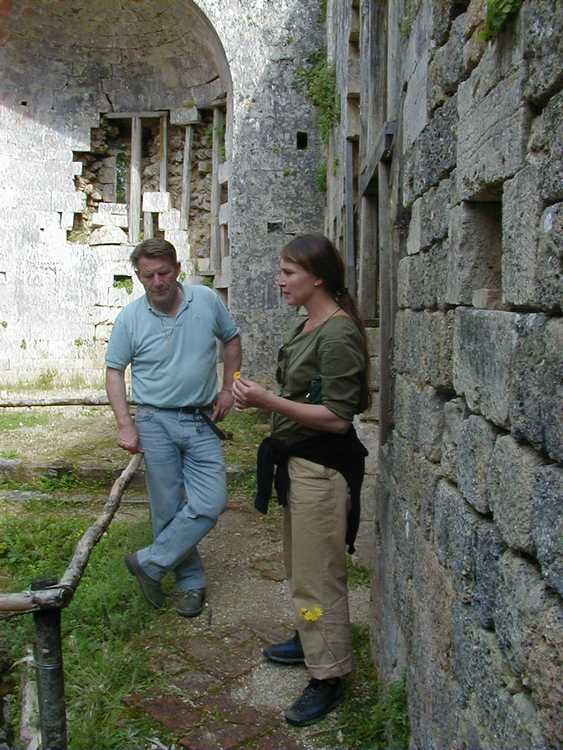
main site of the ruins has the shell of the former church, and a variety of
other bits and pieces. When we first arrived we were puzzled by several
features, such as a pit in the interior of the church. Sylvano explained all
these and much, much more! He showed us how the front wall of the
church needed to be straightened, and explained that they would tear
down the side walls, numbering each individual stone and then rebuild it
while reinforcing the walls with cement. He explained to us in great detail
the reconstruction of a crushing site for grapes, olives, and wheat. He
showed us a stone that looked as if it had fallen from the front of the
church. But by noticing two grooves in the sides of the stone, his team
determined that in fact it was part of the door enclosing a cistern for water
next to the church. In fact, the cistern was fascinating itself, having been
set up to receive rain water from the roof of the church along a system of
channels. (Water is very scarce at times in the Tuscan hills, and a system
for conserving rain water would be important to the village.)
[Photos]
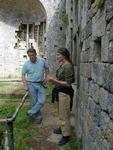
As for our question about the hole in the church floor, Sylvano explained
that it would have been a tomb area where, as he pointed out, the rich but
not the poor would have
been buried. The non-square form of the hole,
which we had noticed, was
so they could dig it around
some very large rocks on
the site.
Sylvano also mentioned
something about the
restoration effort itself. It
is entirely made up of
volunteers, and has been in
progress for 25 years.
(Sylvano himself I think
works for the department of
ornithology at the local
university.) When the
project began, none of the buildings had been reconstructed at all; the site
was mainly woods with stones lying around. Each year many volunteers
come in the summer. In addition, they run a dinner on the site at the end
of May, with medieval costumes and dishes (presumably designed as a
fund raiser).
Dinner is “on your own”. Most of the group decides just to wander around.
There is one recommended restaurant in San Gimignano, Dorando. Millard
and I are the only ones who decide on this, for which reservations are
recommended (and made for us by Verena). Millard, in his real life,
teaches finance and accounting for a large insurance company, specifically
to credit unions supported by the company. He told me he traveled 95000
miles last year on business. But this trip is his personal reward to
himself.
Anyway, Millard and I arrive at Dorando. The description in Michelin
suggested a restaurant specializing in traditional Tuscan dishes, but the
overall impression given is not that at all. Dorando seems to be trying for
a more modern, “creative” slant on Tuscan food. Overall, their reach
exceeds their grasp, and some of the presentation is marred by a
combination of amateurish execution and slightly pretentious touches. Of
the latter the first and most ridiculous is a ceremony, recently introduced in
a few restaurants, of washing the wine glasses in the wine. In this, the
waiter pours a little of the chosen wine into the glass, swirls it vigorously
around and then pours it out. The theory, to give it too honorable a term,
is that this ensures that no “foreign” taste or aroma will be retained in the
glass. (How about a good rinse from the dishwasher, I hear you ask.) This
is stuff and nonsense for any wine, and in our case the wine was a modest
non-classico Chianti “Senesi”, Caulio 97. It needed something, more fruit
from the grapes perhaps, but rinsing the glass was not the solution. To be
fair, the wine was quite pleasant and developed some body as time went
on.
Millard and I shared our dishes; he just out and asked the waitress for two
extra plates with each course so we could split. I, the nominated food and
wine expert, would never have thought of doing this. But Millard was
unembarrassed and the waitress seemed pleased, once she understood the
point. For first course we had roast quail with salad, and spinach puree
with stuffed artichoke. (All the names here are my simplification from
memory of the long sentence defining each dish in the menu–in English,
French or German, but on our menu not in Italian.) The quail was
somewhat dry and the accompanying “little salad” was a few leaves of baby
spinach. The puree was quite nice, the baby artichokes overcooked, just a
little, but please, this is Italy! Second course: risotto with porcini, and
green pici (a spaghetti-like pasta, round pieces cut slightly shorter than
spaghetti) with a green sauce whose ingredients were a bit obscure
(fennel? mint?) but in any case overdone. The risotto, however, was very
good and very simple. The porcini sauce was succulent–definitely the best
dish of the night. For secondi: breast of duck, and sole and salmon roulade
(they didn't call it that, but the salmon was rolled inside the sole and the
whole wrapped, in leaf (lettuce?)). The duck breast was good, cooked a bit
more than my taste but well within reasonable limits. The sole and salmon
mixture was not really successful. Nothing major wrong but the fish was
not spectacularly fresh and the combination did not really convince.
For dessert we both chose assorted pastries with VinSanto sauce,
accompanied by a glass of VinSanto. Nice little cakes and pastries, to my
amateur taste not especially Italian, but pleasant. And accompanied
appropriately by the VinSanto–a rich, nutty sweet wine with the color of
sherry (and Millard insisted, some of the flavor of Harvey's Bristol
Cream–not a bad comparison).
All in all, worth trying but not a real success.
May 16; San Gimignano to Castellina
After two days of rather intense walking, today is pretty slack. Nothing
happens until 11am. Meanwhile, I do some editing on the diary, take a trip
to the Bancomat for more money, and do a little shopping (mainly a
Parmesan grater in an olive wood box). The throngs of tourists around
10am on the route uphill from the parking lot into the town are so thick it's
hard to move in the opposite direction (and we're still only in May!).
First on the agenda is a visit to the town itself, and in particular to the
church of Santa Maria Assunta. Fine frescoes from the 14th century,
illustrating stories from the old and new testament. The main special
feature is the chapel of the local patron saint, Santa Fina (see the green
guide).
Early lunch at a local café; a delicious bruschetta (Gorgonzola, tomatoes,
and rugula). As yesterday, the Gorgonzola is soft, runny, and fresh–much
less harsh than we are used to. Likewise the rugula has a largely sweet
taste with little of the harshness typical back home.
The walk is out of the St. Mathew gate and then spirals around to leave the
town, passing along country roads past some elegant villas and more
vineyards. Less spectacular and less challenging than yesterday, but with
some excellent views of San Gimignano. I have started to record some
closeups of flowers, and continued along the road today. Included are
Sambucco (a bush and tree from which the liqueur is made), wild mustard,
broom, an unidentified red-purple flower (cyclamen?), and of course poppy,
the red carpet seen everywhere this time of year.
After a little under 4 miles, the bus picks us up and takes us to Colle di Val
d'Elsa. In a little park, under the shade of some huge linden trees, we
pause for gelatto from another well-reputed gelateria, Lido. I try a nocciato
(hazelnut) and then a frutti di bosco. Both excellent; the hazelnut is among
the creamy gelati, and certainly up to comparison with any ice cream. (Vs
Bertillon? Hard to say, but certainly not obviously inferior.) The fruit
sorbet is up for comparison with Sergio Dondoli in San Gimignano. Lido's is
somewhat smoother, which I prefer, but Angelica points out that Lido may
be adding a touch of cream, accounting for the smoothness. Anyway, we
should only have such choices to worry about.
[Photos]
An exhibition of crystal cutting at a crystal shop next. Mauro (the master
cutter, one of two brothers, now well on in years, who own the shop)
produces a wine glass with an elegant design of flowers, both stems and
blooms, in a couple of minutes of minimal cutting. Phil and Sue end up
“winning” the glass produced, in a contest of answering questions about
the tour that mainly demonstrates that none of us can remember any of
the names of the restaurants, etc. that we've seen. I checked out the
simper wine glasses in the shop; while they are fine, they seem if anything
slightly coarser than our current collection at home. Finally a walk down
through the town to the bus, and a ride to Castellina in Chianti, and the last
hotel of the tour, villa Casalechi. Huge grounds, part wooded, part in
vineyards, and a 19th century villa. Somewhat more elegant than San
Gimignano, and considerably more so than Sienna.
Dinner at the villa. Generally excellent (see the printed menu). Particularly
good are the artichoke flan starter and the almond/chocolate cake for
dessert. Slight reservations on the radicchio risotto: the risotto is well
prepared, but the radicchio really too bitter. The duck-with-orange Tuscan
style is excellent; as often, distinguished from the French version by being
particularly fresh and less rich. The chef at the villa is young and
promising. (See the May 18 dinner)
May 17; around Castellina
Delightful morning walk past vineyards, occasionally through woods.
Interesting memorials to resistance fighters (as we have seen before;
the Italian memory of World War II seems to have conveniently
forgotten everything up to the removal of Mussolini). A road-side
cross decorated with spear and hammer, apparently a traditional
memento of the Crucifixion.
[Photos]
[More Photos]
Lunch: outdoors under a tent at a charming little restaurant. We're all
more or less wiped out from the long walk and/or the heat, so the shade,
the breeze, and of course the meal itself are an oasis. Never did plain
mineral water seem like such a luxury! Insalata mista; Minestrone de
vedura; Panna Cotta. Just a little lunch, no meat. But the Minestrone! All
of life condensed into a bowl of vegetable soup! With a very generous
dose of olive oil, the stock is extremely intense, herbal but not in any overt
sense. The vegetables themselves are, need it be said in Tuscany,
intensely flavorful and distinct. As a practical hint (not that there's much
chance of exporting this dish), the vegetables (zucchini, carrot, tomato,
celery, and others) come in large chunks so each piece can be savored.
individually. Verena orders the same soup, and has the same reaction:
later at dinner she's still remarking to me on how good the soup
was–Verena swirls in some olive oil, in the Tuscan tradition, but I have to
say for my palate there is just the right amount of oil to start with.
Wine tasting at La Castellina: Chianti Classico 1999; Chianti Classico Riserva
1997; “Super Tuscan” Riserva 1997 (label name Reale). Super Tuscan
wines are riservas made with special treatment: initial aging in small barrels
(“barriques” in the French term usually used). The wines are all fine,
without sending me into ecstasy. The usually expected distinctions. The
1999 is intense in color (“ruby” in Andrea's phrase), the 1997 riserva purer
in both color and bouquet. The Reale is clearly meant as the climax, higher
in tannin and more intense generally. As Andrea says, it is extremely
persistent, with a taste that lingers remarkably (but maybe not entirely
pleasantly for me). Those of us with opinions on the subject agree in liking
the Riserva best. In answer to a question about aging, Andrea suggests
that Chianti needs several months in the bottle before it stabilizes and that
then it should continue to improve for about 5 years, but should not be
kept much longer than that, because it will then go down hill fairly quickly.
We will have some good pictures of the wine tasting, because Phil and I
have been sharing duties on the digital camera. Phil has had an amazing
sequence of careers. In addition to the stint as a pop musician, he has
been a newspaper photographer, hotel (well, B&B) owner, farmer and
attempted-wine-grape-grower, ski instructor, and others roles I missed as
they went by. Susie says they seem to change careers every 6 years. The music, though, has been his constant passion, according to
Susie.
[Photos]
Dinner: This is what I had hoped Dorando would have provided! A view of
the traditional Tuscan meal that allows for imagination and a bit of luxury,
while retaining the spirit of the tradition. Antipasti: Zucchini flowers stuffed
with ricotta, sage and carrot; Fried sage leaves (don't look like that, they
were extremely good–the intensity of the sage leaf tempered by a delicate
batter); Pork (well, really pork fat mainly) with cannellini beans; Lamb
croquette; Flan of vegetables (I forget which), a scrumptious layering of
textures and flavors; Crostini with pancetta and mushrooms. (And that's
just the first course: to be sure, small pieces of each, but a whole world of
flavors already).
Pasta: Ravioli made from chestnut flour, stuffed with wild boar and flavored
with fresh rosemary (hey, you just pick it along the road as you walk); then
spaghettini with wild asparagus and pignolia.
Secondi: Guinea fowl with juniper berries, accompanied by asparagus. One
has to mention that the asparagus in this case were only so-so, just to be
convinced that real humans do create these meals.
Dolci: Another spread of small helpings of many exquisite things. Hazelnut
“demi-fredo” with honey (a demi-fredo is essentially Gelatto, but very soft,
so it has more the texture of panna cotta); Spumoni flan with lemon
liqueur; ricotta with strawberry sauce; Terrine of chocolate and almonds
with orange sauce. Then, in case you're feeling peckish, they bring along
another tray of little tidbits: Dried blood orange and apple; Crostada with
orange sauce; Meringues.
Wines: For white, Greco di Tufo Late Harvest 1999 (Frevdi di San Gregorio,
a wine of Campagna), and then, since Verena wanted to stick with white
wine for herself, the waiter (actually, I think the owner) just brought along
something else to try, a Pietracalda also 1999 Later Harvest from the same
vintner. For red, Chianti Classico Felsina(?) 1998. For dessert, a Muscata
di Asti sparkling semi-sweet. The whites were quite interesting and
intense, especially the Pietracalda. The red was well in the range of the
delicious fresh Chianti's we've been having.
May 18; Around Castellina
After some shopping time in Castellina, a downhill (on the average) walk
from near Castellina to the Lilliano winery (Tenuto di Lilliano) to the
southwest. Picnic lunch on the estate of the winery. At the end of a
double row of cypress trees, on a promontory with 360 degree view of the
surrounding hills, is a ring of cypress trees. In the center of a ring stands a
single pine. In the shade of this pine we have a picnic lunch chosen by
Angelica and Verena. The site is pure magic; as Phil says “One of the most
beautiful spots I've ever seen.” Private and undisturbed, but with views to
the farthest distance in every direction, swept by a strong breeze from the
sea (Sauro says traditionally this means that the sea is angry with us, but
that in turn means no rain.)
[Photos]
A delightful lunch of various typical Tuscan dishes: Bread, olive bread and
focaccia; Pancetta cooked and smoked; salami; black olives and green
olives (aged in oil and herbs); fresh Pecorino and fresh Gorgonzola; truffle
paste (similar to that on the eggs at San Donato) and olive paste; artichoke
hearts; cherry tomatoes (wonderful!) and fresh basil; chestnut honey.
Fruit: strawberries, pears, peaches, nespola (medlar fruit in English, and
spectacularly delicious–tart and firm but at the same time juicy with an
intense flavor; Susie says they start out with a taste of tangerine.
According to my menu master, this fruit grows wild in Europe. Also, I
think it is mentioned in Shakespeare–Antony and Cleopatra?); the first
cherries of the season. 1999 Chianti from Lilliano.
A Tuscan picnic habit is to put honey on Pecorino cheese. The honey is a
blast: a suggestion of hay (Phil) and a terrifically intense flavor. Too strong
perhaps for everyday, but tremendously exciting. On cheese though? I
don't think so, not on my first try anyway. But on focaccia it's fabulous.
It's all wonderful, with perhaps the nespola, the honey, the cherry
tomatoes and the truffle paste at the top of the taste list.
Back to the hotel and an afternoon off (the trip itinerary had another
winery on the list, but presumably this got cancelled by the winery).
I take a walk on the road past the hotel, and then onto an off-road track
(not used apparently, since I keep brushing into spider webs). Interesting
flowers. Seems to be a hunters' trail, judging from the “Uso da caccia”
sign. At the end of the trail is a clearing with wooden constructions
appearing to be some form of hanging racks, and what looks like a hunters'
blind. Interesting.
[Photos]
Dinner at the Villa. This time the chef (Aldo) does a totally sea food menu.
Very enterprising and on the whole successful. The swordfish carpaccio is
quite astonishing; by slicing the swordfish (smoked and marinated in lemon
juice) very thin, he creates a fascinating texture. Quite a remarkable dish.
The seafood soup is very good, though this part of the meal is pretty
standard Tuscan fare. The Paccheri pasta with “vongole” (small mussels) a
fine dish. Quite enterprising is the seabass in parchment: as in most
successful parchment dishes, it's the aroma on opening the package that
makes the really spectacular effect. And lastly, an apple mille-feuille with
Calvados that is really special. Only two reservations: the reuse of the
same shellfish two or three times in the meal risks monotony. And they
really shouldn't have gone ahead with the usual red wine to accompany an
all-fish meal.
The young (24!) chef comes out to great us afterward. Very charming,
handsome, originally from Naples. He says he did the fish meal because he
was fed up with the Tuscan emphasis on meat. And as to the dessert
being French, he claims the Italians taught the French how to make puff
pastry (could be true) and that the Italian version has much less butter
(this does indeed seem to be the case). This is a cooking talent to watch–I
suspect he will be lured away to a more prestigious location soon (maybe
even to New York?).
May 19; Castellina to Firenza
Breakfast: the young waiter from Sicily (Flavio) serves us each as a treat
“Neapolitan coffee”. This comes in a liqueur glass, double strength
espresso with lots of sugar. It will start your engine in the morning I
anything will.
Drive back to Florence through yet more spectacular scenery. Warm
farewell to Angelica, Verena, and Sauro.
Today is the day the Mille Miglia goes through Florence (one more of the
remarkable coincidences on the trip.) I'm not a real fan, but this is a very
old racing tradition in Europe, now turned into a tour for vintage sports
cars. I'm not so much into this anymore, but it's worth checking out.
First, though, I take a taxi to the hotel (way up the hill), leave my bags
because it's only 10:30 and the room isn't ready, and then walk back down,
over the bridge and to the Medici-Riccardi Palace. Verena had
mentioned
an exhibit there on theater in the Medici period. Indeed, it's great,
showing the origins of stagecraft in spectacles put on in churches in the
15th century, then gradual evolution into proscenium format and then into
permanent theater buildings. Amazingly, the palace and the exhibit are
relatively uncrowded, despite the immense throngs a couple of blocks away
in the market and at San Lorenzo.[Photos]
Also in the palace: a small Medici chapel with frescoes illustrating the Three
Kings (in principle; in practice it's a whole culture on display, with hunting
and vast numbers of ordinary people from Florence in general, and the
Medici family in particular. Utterly magnificent, because of the state of
preservation and the relatively compact room. The frescoes, along with the
rich abstract decoration in ceiling and floor, envelop the viewer,
transporting him into a whole world, albeit one with distinctly nonstandard
rules of perspective. Along with the libreria in the cathedral in Sienna, this
room gives the most vivid impression of how effective the art of fresco
must have been before time dimmed or erased so many. Here is one
aspect of art whose masterpieces must be visited, rather than being
transported or copied.
Lunch: a pick-up cheese and tomato sandwich (strettachina?) and water
from a stand. Florence really likes me: just as I'm wondering how to eat
this on the run, I notice a lovely little park next to the road, where I can sit,
eat, drink my water, and relax until ready to face the outside.
After lunch, a bit more wandering around, then up to the Piazzala
Michelangelo, recommended at the Classic Hotel as a place to see the
Mille Miglia. The Piazzala is on the far side of the Arno, parallel
to my hotel, and about half or more of the same elevation. It offers
some excellent panoramic views of central Florence (of course, by now
I'm almost jaded by such views!). While waiting for the drivers,
observations of two different wedding parties; not surprisingly,
couples come here to be photographed (or video-ed) with Florence in
the background. But they and the photographers also make a neat photo
op for those of us on the level above.
After a while some of the cars start to arrive. First a group of
Lotus-es (Loti?) from club Lotus of Italy. Eventually about a dozen
pull in and stop for a rest, more contiguous examples of that rare car
than I have ever seen in one place before. But rarer is to come: The
next group that collects are Dutton's, a brand totally unfamiliar to
me, and mostly driven by Germans, although the car itself looks
vaguely British. Miscellaneous other arrivals, many dating back to
the era when I actually was a fan (the late 50's: an MG-A, a Jaguar
XK 140, a Mercedes of the same era). Then, of course, a red Ferrari,
symbol of upper-class Italian motoring. Most attractive of all,
though, is a red Morgan with cream leather seats, in impeccable
condition. The other great incidental is a little boy with an older
man in a marvellous handlebar mustache (his grandfather?) on a Vespa.
The boy is delighted to have his picture taken (alas the picture will
need some work to brighten it up--later).
[Photos]
The Mille Miglia was originally a serious race, on ordinary streets
for a thousand miles. Nowadays, that would be impractical. Instead,
it has become a tour for vintage sports cars; from the number of cars
and the excellence of their preservation, this is clearly one of the
highlights of the international circuit.
My capacity for cars, though, is finite, so after about an hour I
decide to head back to the hotel.
A passing taxi with a woman driver (first I've seen) is available.
Well, not to worry, I do get to see a good deal of the tour anyway,
since the taxi's route has largely been commandeered for the tour.
So, while we wait in long traffic jams, the cars on the tour roll by
on the other side of the road. That's OK, at least the seat is comfortable.
Dinner: Wild place (Angelica's suggestion: Big crowd outside trying to push
in, not clear that our reservation means anything, but at least we do
eventually get in. Hearty Tuscan food, very noisy, much like Alla Vecchia ...
near my hotel but really “in”. The usual menu, nothing very notable, but I
have a tasty ravioli, roast lamb, and the usual antipasto. Ice cream and
(excellent) strawberries for dessert. Our hiking group has one last great
meal together, much laughter and talk. You know it's a real group of
eaters when we spend the time during this hearty meal discussing details of
the previous meals on the trip! We seem to be a hit with the waiters as
well; they present us a bottle of a really nice sweet spumante with our
dessert: “La Caudrina” Moscata d'Asti.
An emotional farewell, hugs all round, and a walk back to Torre di
Belosguardo.
May 20; Firenze
Notes for the May 20 photos: 1-2, Hall of the Five Hundred, Palazzo
Vecchio; 3-4, views across the Arno from the balcony of the Palazzo
Vecchio (Belosguardo is probably one of the hills); 5, sign for a
contemporary art exhibition (was this the artist Phil mentioned–he paints in
an applique style with hints of Cezanne); 6-8, attempts to photograph a
very striking anonymous reliquary head from about 1380 in the Museum of
Sante Croce; 9, view from Belosguardo garden (again).
This was my last day for museums, etc. in Florence and I had planned it as
a sort of make-up for missed spots in the first half of the visit. As it turned
out, that did not work as well as hoped, but Florence is so rich in art that
off-the-cuff alternatives can hardly miss.
My first stop was to have been the Academia, with its rich collection of
Michelangelo statues. I was particularly interested in his series of “slave”
statues. The catch: they also own the original of the David. So on a
Sunday, there was this line winding around the block waiting to get in.
Forget it!
The other problems was the Bargello, with among other things a fabulous
Donatello collection. Here the catch was an eccentric schedule that
alternates Sunday and Monday closings. Given that I only had Sunday, no
prize for guessing which day it was closed this week.
Never mind, there was plenty left. Starting with the
Palazzo Vecchio and some fascinating room designs,
showing the range of interior styles that (at least as
chosen by Vasario) represented late 16th century taste.
In the large conference hall (“Hall of the Five Hundred”)
some sort of official meeting going on, complete with the
city flag, and renaissance costumes for both speakers and “guards”.
In the afternoon I went to the cloisters and museum associated with Sante
Croce. Here again the main event (in this case the church itself) was
mobbed but the adjacent collections (in their own way at least as
interesting) are not on the “required” tour and were
largely empty. On each art-oriented trip, I tend to be hit
by one surprise piece that visually knocks me over. It
needn't be either large or famous (e.g., a pair of tiny
bronze leopards in a China exhibit at the Met years ago).
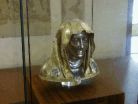
Here I received the “hit” of this trip: an anonymous gilded
bronze reliquary head from about 1380. The folds of the covering, the
delicacy of the face, the haunting, melancholic expression, reached out and
grabbed me. The photo is blurred because I couldn't hold the camera
steady enough (and flash destroys the delicate textures), but it still conveys
some of the magic.
Evening: Verdi Requiem at the Teatro Communale with the Maggio
Musicale Chorus and Orchestra, Zubin Methta (see program book for
soloists). Briefly: exciting performance, not perfect–orchestra and (large)
chorus very good, soloists not quite of the first rank. Mehta definitely
inclines to the operatic end of the opera-religious spectrum of
interpretations of the work. A fine, really Italian finish to the trip.
The Teatro Communale is a large, richly laid out, relatively modern
auditorium; the seats are ranked in a sufficient upward slope to give one a
clear view if the person in front is not excessively tall. The seats are
comfortable, perhaps a bit more than optimal, both for staying awake and
for my back. The concert is essentially sold out, bar a few seats at the
back of the near-stage boxes. It's encouraging to see a wider spectrum of
ages than at most North American concerts; along with the prosperous
middle-aged, there are substantial numbers of twenty-ish, and even a fair
number of teen-agers. Along with the range of ages goes a range of dress
styles. I follow the formal option–blue suit, blue shirt and tie, which does
seem to be a common uniform. But open-necked shirt with sports jacket,
and even blue-jeans, sneakers and short-sleeved shirt (on the teen sitting
next to me) is accepted with no complaints. A similar range of clothing for
the women, from knockout designer fashions to housewife-plain skirt and
sweater. One of the features I like about Italians is that while they
appreciate stylish clothing, and often like to dress up, they never make a
fuss about it. Even the most elegant restaurant we went to, in Sienna,
served someone in a tee shirt with not a blink.
A little more on the performance: the four soloists are all Italian-born, all
seem quite young, and all did a perfectly fine job, but with enough caveats
that I wouldn't rush to predict a great future for them. But the point of the
performance, for me anyway, was a celebration of Italian music and Verdi
as part of the May Festival in this Verdi centenary year. Mehta went for the
big splash (not really surprising for those who remember him in New York).
Until reading the program notes, I did not realize he has been principal
conductor of the May Festival Orchestra since 1985. It's clear that
Fiorentini love him.
Mehta's approach went for the dynamic contrasts: the opening pp was a
mere whisper; the opening of the Dies irae was a huge roar. Both
orchestra and chorus responded with full enthusiasm to this approach. The
chorus was large (well over 100, I would say) but for the most part
retained clarity of diction and unanimity of attacks. As in the Handel, I
thought the orchestra technically a great improvement on the old
recordings from the Festival twenty or more years ago. The brass in
particular were vibrant.
The acoustics were excellent, but therein lies an interesting point. A sign at
the entrance to the hall thanked Philips corporation and others for the “new
sound system” in the hall. Hmm? Amplification? I didn't notice any
obvious artificiality, but once alerted, perhaps the sound was unusually
immediate for what is a rather large hall. Never mind, the performance
was committed, the music is wonderful, the audience was happy, and it
was a fitting finale to my program in Italy.
During the concert it started to rain, lightly. Apparently Florence taxis
disappear as quickly as their New York cousins as soon as it rains. The taxi
stazione I scoped out before the performance was empty. So, while
wandering along looking for a free taxi, I ended up walking to the hotel (for
the second time today).
John Chambers<jmc@research.bell-labs.com>
Last modified: Sun Jun 3 17:53:02 EDT 2001
 This may look like one of the standard glossy cocktail-table-book photos of the Duomo, but in fact its taken
from the window of my hotel room (or suite). Later in
the afternoon after checking in, I walked down to the
cathedral and, yes, the dome is really as beautiful and as
fascinating artistically as all the hype suggests. When
my first view of Florence from the hotel was this, small
wonder I was bowled over! And, from other windows,
essentially all the famous Florence views appear.