The W3C OWL Web Ontology Language has had significant usage in the five
years that it has been a W3C recommendation. OWL is just finishing its
first revision - OWL 2 is currently a W3C candidate recommendation. To
take OWL from its representational roots in Description Logics to its
current status has required research in effective representational
constructs, the computational complexity of reasoning, algorithms and
tools for reasoning, and user interfaces for building ontologies. Just
as important have been non-research activites - not only the development
of reasoning and user interface tools required to support the above
research - but also much work on fitting OWL into the W3C view of the
Web, such as merging the semantics of OWL and the semantics of RDF,
using datatypes from XML Schema in OWL, and transferring OWL information
as XML and RDF. Both kinds of work were vital for the first version of
OWL and both kinds of work have remained important in the OWL 2
revision. This talk will describe much of the work underlying OWL,
concentrating on the portion of the work most involved with OWL 2.
What is OWL?
A KR language based on Description Logics
... thus a logic with denotational semantics
... thus decidable
... thus has effective reasoners
The W3C Recommendation for a Web Ontology Language
... thus a Semantic Web language
... thus gets a lot of use and attention
OWL can be considered as ...
... a fancy databasey language
... a language for representing ontologies
... a language for representing facts (about the world)
... a language for representing incomplete information
What does OWL do?
Represent information about classes, relationships, and individuals
in a domain ...
e.g., People have exactly one age and exactly one gender
which is either male or female
e.g., Parents are people who have at least one child
... in situation with incomplete knowledge ...
e.g., Chris is a person (but of unknown gender)
e.g., John is a Parent (but with no known child)
... but reasoning is still effective
sample query: which individuals are Parents?
OWL Ontology Fragment
Namespace: = <http://ex.com/owl/families#>
Ontology:  <http://ex.com/owl/families>
Import:    <http://ex2.com/owl/family.owl>

ObjectProperty: hasWife
  Annotations: rdfs:label "moglie"@it
  Domain: Man    Range: Woman
  Characteristics: Functional,
      Inverse Functional
  SubPropertyOf: hasSpouse, loves
ObjectProperty: hasChild
  Domain: Person Range: Person
  SubPropertyOf: inverse hasAncestor
ObjectProperty: hasAncestor
  Characteristics: Transitive
DataProperty: hasAge
  Domain: Person Range: integer
  Characteristics: Functional

Class: Person
  SubClassOf:
    hasAge exactly 1
    and hasGender exactly 1
    and hasGender only {female , male}
Class: Man
  EquivalentTo:
   Person that hasGender value male
Class: Parent
  EquivalentTo:
    Person that hasChild min 1
Class: YoungChild
  EquivalentTo:
    Person and
      not (Teenager or Adult)

Individual: Jeff
  Types: hasChild exactly 2
  Facts: hasGender male,
         hasWife Emily,
	 hasChild Ellen,
	 hasChild Jack,
	 hasAge  77,
	 loves Jeff
  DifferentFrom:
    Ellen, Jack, Susan, Emily

Individual: Emily
  Types: hasAge some { 39 , 59 }
Description Logics
academic discipline
family of knowledge representation logics that represent
information about classes, properties, and
individuals
concentrates on complex classes with possibly complete
definitions
try to simultaneously
maximize useful expressive power
retain "effective" reasoning
initially: polynomial worst case
currently: fast in practice
Why do OWL?
OWL is basically a Description Logic, so why bother to spend the
large effort to produce OWL?
Usage!
An academic project may have a few or perhaps a dozen uses.
An academic discipline may end up with a hundred uses.
OWL (in various guises) has (almost certainly) thousands of uses.
What was needed to achieve OWL?
Appropriate Description Logic
Sufficient expressive power (ALC, SHIN, SHIQ, SHOIN)
Decidable
With adequate extras (datatypes, annotations, ...)
Effective tools, both reasoners and development interfaces
Agreement from the research community
On common input syntax, common API, ...
"Seal of approval"
Standardization by some well-known group
Want to be in Semantic Web, therefore use W3C
What is the price to get this seal of approval?
Description Logic Research Underlying OWL
Complexity Analysis (using automata theory techniques)
SHOIN reasoning is EXPTIME-complete
Effective Reasoning Algorithms
Tableaux with blocking
Hypertableaux with anytime blocking
Reasoning Optimizations (many language-specific)
input rewriting, avoiding reasoning, ...
backjumping, caching, ...
aggressive blocking, heuristics
Reasoners (FaCT, DLP, Racer, Pellet, Hermit)
Embody difficult symbolic programming
Empirical analysis needed to test optimizations
Reasoner Demo
Underoptimized reasoner
idefix > dlp --nooptimize galen.owl
   [Wait for heat death of universe]
OK
Optimized reasoner
idefix > dlp galen.owl
   [Wait for 2 minutes]
OK
Newer optimized reasoner
idefix > hermit galen.owl
   [Wait for 15 seconds]
OK
Examples are illustrative only; your results may vary.
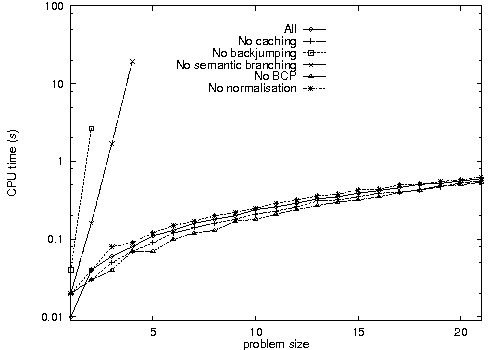
Empirical Analysis of Reasoners
Note log scale!
Other Research Underlying OWL
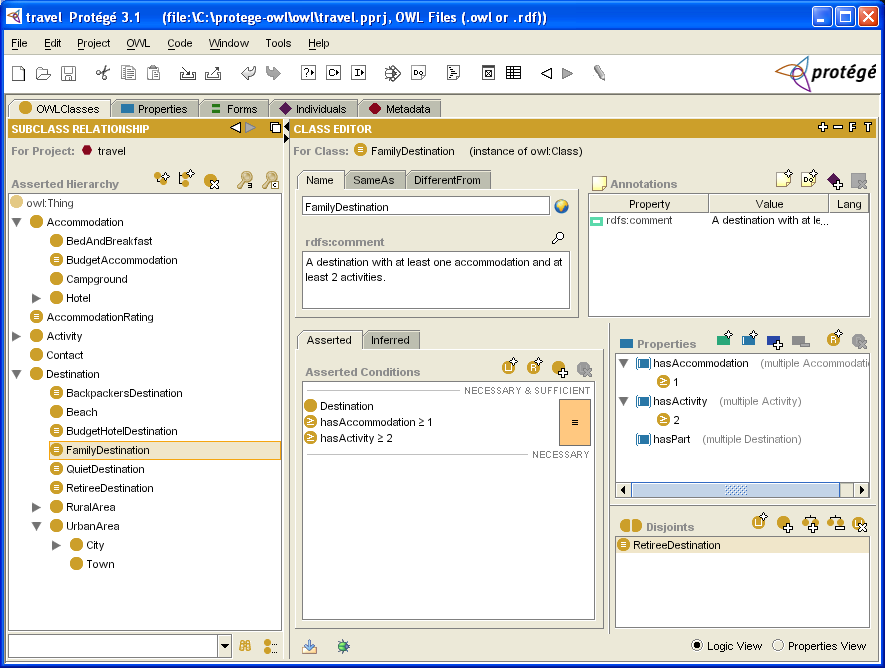
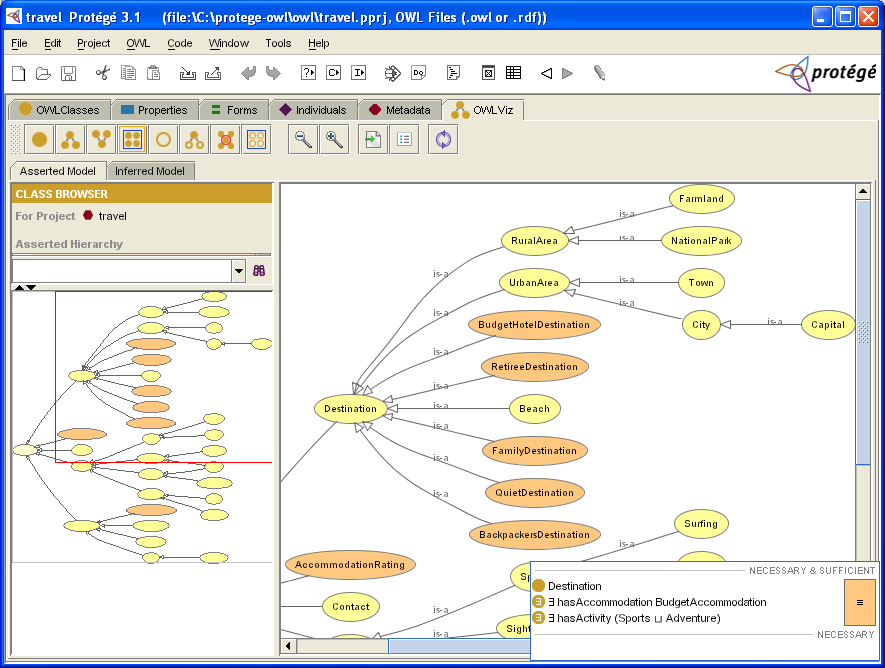
Graphical User Interfaces
e.g., SWOOP, Protégé
Help developers build OWL ontologies
Lots of work left to do here
Explanation
Reasoning can be surprising!
Allow developers to see why something was deduced (or not
deduced)
Lots of work left to do here
Protégé
Protégé
The Last Mile for OWL
So far everything looks good
Good theoretical foundations
Good reasoners
Good tools
Nothing yet has anything to do with the Semantic Web
The "last mile" from Description Logics to the Semantic Web is
needed to get W3C approval
Actually several last miles
Some are easy, some interesting, some boring, and some ugly
Last Miles for OWL
Identifiers are URIs (or IRIs)
Easy
e.g., http://ex.com/owl/families#Person
Syntaxes have short forms (e.g., ex:Person or Person)
No unique name assumption
Interesting
e.g., Jack and John may be different names for the same
individual
Need explicit statements to assert difference
Individual: Jeff DifferentFrom: Ellen
XML Schema datatypes integer and string
Easy
xsd:integer is the class of all integers
xsd:string is the class of all Unicode strings
Last Miles for OWL
Annotations
Boring
Non-logical information about a class, property, or
individual
E.g., Who created it, when it was created
OWL has an RDF syntax
Ugly
OWL constructs as RDF triples
How to extract OWL constructs from sets of RDF triples
What to do with partial constructs?
Every set of RDF triples has an OWL semantics
Ugly
Need a semantics that extends RDF semantics
Need to account for every OWL construct
All triples have semantics (even annotations)
Time Marches On
OWL becomes W3C Recommendation in Feb 2004
OWL reasoners built
FaCT++, Pellet, Racer
Based on optimised tableaux reasoning
OWL Full implementations built
Mostly rule-based, implement only a fraction of OWL
Full
Definitely not complete
Users increase
Use of OWL in bioontologies, etc.
Users want more expressive power
Description Logic theory advances
Algorithms for qualified number restrictions (SHOIQ)
Algorithms for some role chain
inclusions (SROIQ)
Let's update OWL to take into account (some of) this!
New version of OWL - OWL 1.1
An update to OWL in response to requests by users, but changes
limited to those with both theoretical underpinning and support
from implementations
Added expressive power (SROIQ)
(ir)reflexive and (a)symmetric properties;
disjoint properties;
qualified number restrictions;
limited role chain inclusions;
self-restrictions; keys;
enhanced datatypes
Nicer syntax for some commonly-used constructs
Annotations with no formal meaning
New formal syntax - closer to DL syntax
New W3C version of OWL - OWL 2
Want W3C recommendation for new version of OWL
Need to do "last mile" work again
Context is different
more use of RDF
XML Schema 1.1 in process
...
so the last mile has
different characteristics
Last Miles for OWL 2
Higher-order facilities
More datatypes and datatyping facilities
OWL 2 documents in the Web, with versioning
New XML syntax
Translation from XML syntax to RDF syntax
Fragments of OWL 2
Status of surface syntaxes
Semantics for OWL 2 Full
Relationship between OWL 2 and OWL 2 Full
Higher-order Facilities
Want to say things about, for example, class names
e.g., "Lion" (the class) is a subclass of animal and "Lion"
(the individual) is a species
Can be done via ...
a higher-order logic (but beware undecidability)
a first-order trick (but beware semi-decidability)
in the usual manner (not affecting decidability)
Description Logics use the third option;
RDF uses the second
OWL originally just forbade the multiple use of names
OWL 2 uses the Description Logic option
Easy -
Political (OWL vs RDF)
Datatypes
More than integer and string
Decimals, rationals, reals
Floats and doubles
Boolean, binary, IRIs, time instants
Strings with language tags
Are reals and floats disjoint?
Which version of XML Schema datatypes?
Version 1.0 has problems (not sufficiently formal)
Version 1.1 not finished yet
Easy -
Political (timing, which datatypes)
Datatype Facilities
Want ranges, e.g., integers between 13 and 19
e.g., Person that hasAge some integer[>= 13 , < 20]
Use XML Schema datatype facets
Again, which version?
Allow many reasonable facets
How many integers between 13 and 19?
How many reals between 1.0 and 1.1?
How many strings match a regular expression?
Not easy
Ontologies in the Web
MIME types and extensions for OWL 2 documents
OWL 2 documents have an ontology IRI and an optional version IRI
Stored at the version IRI if it exists
If the document is the current version, then (also) stored at
the ontology IRI
So http://ex.org/ontology.owl could be current version;
duplicated at http://ex.org/ontology-v2.owl;
older version at http://ex.org/ontology-v1.owl;
upcoming version at http://ex.org/ontology-v3.owl;
Easy -
Political (support for branching versions)
New XML Syntax
Want to allow use of XML tools
e.g., schema validators, ...
What is the status of the XML syntax
Are OWL 2 tools required to understand it
Can RDF tools automatically understand the XML syntax?
GRDDL translation from XML syntax to RDF
Who writes the translation (and how)?
Is the translation normative?
Boring -
Political (may push aside RDF)
Fragments
Why specify fragments (a.k.a. profiles)?
Stamp of approval for different uses
Stamp of approval for different reasoners
Which fragments (and why)?
OWL 2 EL - polynomial-time reasoning
OWL 2 QL - querying can use DB technology
OWL 2 RL - reasoning can be done by a rule system
Political (which fragments, how powerful)
Surface Syntax(es)
RDF syntax is "first among equals"
To keep peace in W3C Semantic Web
XML syntax is "optional"
So that (some) existing OWL tools don't have to
change
Manchester syntax is not a recommendation
Because the syntax is neither RDF nor XML?
Political (place of RDF in Semantic Web)
Semantics for OWL 2 Full
OWL Full semantics would make OWL 2 Full incoherent
Version of Liar's paradox
Revise OWL Full semantics to be less powerful
OWL Full tools are highly incomplete
Therefore change will not be noticeable
Ugly
Relationship between OWL 2 and OWL 2 Full
Some OWL 2 inferences are not OWL 2 Full inferences
Previously all OWL DL inferences were OWL Full inferences
However, this is the case only for "artifacts" due to RDF
RDF requires that everything be a fact
Even things like "This bit of syntax was created by John"
Such annotations no longer have meaning outside of OWL 2 Full
Larger divergence between OWL 2 and OWL 2 Full than between OWL
DL and OWL Full
Needs to be "socialized"
Political (status of RDF)
Conclusion
OWL required much more than just KR research
Consensus amongst KR researchers
UI research (GUIs, explanation)
Relationship with Semantic Web
Tutorials and other publicity
Even the minor changes to OWL 2 required much more than just KR research
Datatypes
Surface syntaxes
Modified relationship with RDF
Some of the non-research parts were tricky to do
Example OWL 2 Ontology (Complete)
Namespace: =<http://ex.com/owl/families#>
Namespace: g = <http://ex2.com/owl/family.owl#>
Namespace: families = <http://ex.com/owl/families#>
Namespace: rdfs = <http://www.w3.org/2000/01/rdf-schema#>
Namespace: rdf = <http://www.w3.org/1999/02/22-rdf-syntax-ns#>

Ontology: <http://ex.com/owl/families>

Import: <http://ex2.com/owl/family.owl>

ObjectProperty: hasWife
  Domain: Person, Man
  Range: Person, Woman
  Characteristics: Functional, Inverse Functional, Irreflexive, AntiSymmetric
  SubPropertyOf: hasSpouse, loves

ObjectProperty: hasHusband
  Inverses: hasWife

ObjectProperty: hasSon
  Domain: Person, Parent
  Range: Person, Person that hasGender value male
  SubPropertyOf: hasChild
  DisjointWith: hasDaughter

SubObjectProperty: f:hasSpouse o f:hasSon f:hasSon **

ObjectProperty: hasDaughter
  Domain: Person, Parent
  Range: Person, Person that hasGender value female
  SubPropertyOf: hasChild

SubObjectProperty: f:hasSpouse o f:hasDaughter f:hasDaughter **

ObjectProperty: hasGender

ObjectProperty: hasChild
  Domain: Person Range: Person
  SubPropertyOf: **INVERSEOF** hasAncestor

ObjectProperty: hasAncestor
  Characteristics: Transitive, Irreflexive

ObjectProperty: hasSpouse
  Characteristics: Symmetric, Irreflexive

ObjectProperty: loves
  Domain: Person

DataProperty: hasAge
  Domain: Person Range: integer
  Characteristics: Functional


Class: Person
  SubClassOf: hasAge exactly 1
	      and hasGender exactly 1
	      and hasGender only ({female , male})

Class: Man
  EquivalentTo: Person that hasGender value male

Class: Woman
  EquivalentTo: Person that hasGender value female

Class: Parent
  EquivalentTo: Person that hasChild min 1

Class: Teenager
  EquivalentTo: Person that hasAge some integer[>= 13 , < 20]

Class: Adult
  EquivalentTo: Person that hasAge some integer[>= 21]

Class: Child
  EquivalentTo: Person and not (hasAge some integer[>= 21])

Class: YoungChild
  EquivalentTo: Person and not (Teenager or Adult)

Class: Marriage
  EquivalentTo: CivilMarriage or ReligiousMarriage

Class: ReligiousMarriage
  DisjointWith: CivilMarriage

Class: CivilMarriage

Class: Narcissist
  EquivalentTo: Person that loves Self


Individual: male
  DifferentFrom: female

Individual: female

Individual: John
  Types: Person
  Facts: hasWife Mary,
	 hasSon Bill,
	 hasDaughter Susan,
	 hasAge  33,
	 hasGender male
  SameAs: Jack
  DifferentFrom: Mary, Susan, Bill

Individual: Mary
  Facts: hasSon Bill,
	 hasDaughter Susan,
	 hasAge  31,
	 hasGender female

Individual: Bill
  Types: not (Narcissist)
  Facts: hasAge  13,
	 hasGender  male

Individual: Susan
  Facts: hasAge 8,
	 hasGender female

Individual: Jeff
  Types: hasChild exactly 2 Teenager
  Facts: hasWife Emily,
	 hasChild Ellen,
	 hasChild Jack,
	 hasAge  77,
	 loves Jeff
  DifferentFrom: Ellen, Jack, Susan, Emily

Individual: Emily
  Types: hasAge some {39 , 49}

Individual: Ellen
  Types: hasAge some integer[>= 15 , <= 21]

Individual: Jack
  Facts: not hasAge "53"^^integer

SameIndividual: f:male g:masculine
SameIndividual: f:female g:feminine
EquivalentClasses: f:Adult g:Grownup
EquivalentObjectProperties: f:hasChild g:child
EquivalentDataProperties: f:hasAge g:age