Semantic Layering: What is it?
by
Peter F. Patel-Schneider
for presentation at W3C Technical Plenary, March 2003.
Abstract
Semantic layering is a current problem in the Semantic Web.
This is strange, as there are many examples of semantic layering in logical
formalisms that have been around for decades.
The problem is that semantic layering in the Semantic Web is a much
stronger notion than what one would think it should be.
Some effects of this very strong notion and how to get around them are
presented.
Semantic Web Vision
- Bring structure to web pages
- Permit software agents to carry out sophisticated tasks for users
- Extension of the current web
(Tim Berners-Lee, James Hendler, and Ora Lassila.
``The Semantic Web''. Scientific American, May 2001.)
Requirements for Semantic Web Languages
Form: The languages used in the semantic web need well-defined syntax.
- Otherwise software agents cannot determine what constructs
they are using.
Meaning:
The languages used in the semantic web need well-defined semantics.
- Otherwise software agents cannot determine what the
constructs that are using mean.
Semantic Web Tower
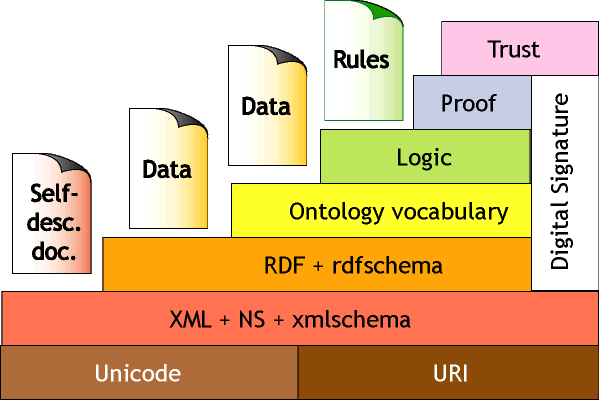
Semantic Web Tower (from Tim Berners-Lee)
The Current Vision of the Semantic Web Tower
- XML is the base syntactic language for the Semantic Web.
- All Semantic Web languages can be written in XML dialects.
- The meaning of Semantic Web language is not necessarily
related to their XML meaning.
- RDF is the base language for the Semantic Web.
- All Semantic Web languages use RDF for their syntax.
- All Semantic Web languages build on RDF for their semantics.
Rationale for the Current Vision
- XML is supposed to be the mechanism for defining all Web languages.
- XML Schema, XML ..., RDF, RDF Schema, OIL, ....
- Different languages are in different documents.
- Base data is contained in XML documents.
- XML systems can parse all Web documents, but will not
understand them.
- RDF is supposed to be the mechanism for defining all Semantic Web
languages.
- RDF Schema, ....
- Different languages are in the same document.
- All information is contained in RDF documents.
- RDF systems should be able to parse and (partially) understand
all Semantic Web documents.
Semantic Layering - weakest version
Definitions:
- A logic is a formal language equipped with a model
theory.
- Entailment is a relationship between top-level syntactic
constructs in a logic defined in the more-or-less usual way.
Semantic Layering:
A logic, Lt, is layered on top of another logic, Lb,
if there is a total mapping M
from top-level syntactic constructs in Lb
to top-level syntactic constructs in Lt
such that
S1 entails S2 in Lb
if and only if
M(S1) entails M(S2) in Lt.
Semantic Layering - examples
- Propositional Logic (PL) and First-Order Logic (FOL) -
note that a non-identity syntactic mapping is needed
here
- PL and modal logics - here the syntactic mapping is identity
- FOL and Higher-Order Logic - here the syntactic mapping is identity
- RDF and RDFS - here the syntactic mapping is identity
- K4 and ALC
Semantic Layering - strengthenings
- Weak semantic correspondence
- Require a ``nice'' mapping from interpretations for Lb
to interpretations for Lt - as in PL and FOL
- Medium semantic correspondence
- Require that interpretations for Lt be extensions of
interpretations for Lb - not as in DL and FOL
- Strong semantic correspondence
- Require that interpretations for Lt be interpretations for
Lb - as in RDF and RDFS
- Weak syntactic correspondence
- Require that the language of Lt be a superset of the language
of Lb - as in FOL and HOL
- Strong syntactic correspondence
- Require that the language of Lt be the same as the language
of Lb
Problems introduced by Strong Semantic Layering
- Medium semantic correspondence
- Can't reinterpret the semantics to make it work in the more-general
setting
- Medium semantic correspondence
- Can't even extend the semantics to make it work in the more-general
setting
- Strong syntactic correspondence
- Can't introduce new basic syntactic constructs
An Inadequate Basis - Syntax Problems
- Triples make syntax unnatural.
- Restrictions have to be split up.
- Collections have to split up.
- DAML+OIL defines a special syntax extension for
collections.
- Triples allow for deviant syntax.
- Restrictions with too many pieces.
- Collections with missing or multiple components.
- Triples allow additions at any time.
- Can't forbid new triples attached to old syntax.
An Inadequate Basis - Semantic Problems
- Everything is triples; all triples have meaning.
- All aspects of syntax contribute to meaning.
- e.g., ordering in collections
- the intersection of Student and Employee is different
from the intersection of Employee and Student
- All syntax refers to something.
- e.g., descriptions live in the domain
- to infer membership in a description, the description
has to exist
- leads to semantic paradoxes
Semantic Problems - A Theory of Classes
A Desirable Inference:
- Premises:
- John is an instance of Student.
John is an instance of Employee.
- Conclusion:
- John is an instance of the intersection of Student and Employee.
- In an RDF extension, this requires that the intersection automatically
exists whenever Student and Employee exists.
- Many more of these examples can be devised.
Semantic Problems - A Theory of Classes
A Unfortunate Inference:
- Premise:
-
- Conclusion 1:
- rdf:type is an instance of the restriction whose instances do not
have an rdf:type link to the restriction itself.
- Conclusion 2:
- rdf:type is not an instance of the restriction whose instances
do not have an rdf:type link to the restriction itself.
Options for Layering on Top of RDF
- Limit inferences in the higher layers
- Use a different semantics for the higher layers
- Allow for syntactic extensions
- Combine the previous two options
Limiting Inference in the Higher Layers
- Remove some of the desirable inferences
- e.g., John a Student and John an Employee does not imply
that John is in an intersection of Student and Employee
- Leads to a difficult-to-explain formalism
- Also difficult to develop the formalism
- just which inferences are retained
Using a Different Semantics
- Higher levels have their own meaning for triples
- similar to the relationship between XML and RDF
- Means that higher levels don't respect RDF meaning of constructs
- not true to the vision of the Semantic Web
Extending the Syntax
- Higher levels use their own syntax for their own constructs
- like the situation between propositional logic and
first-order logic
- Extended syntax does not have the limitations of RDF triples
- can be given whatever meaning is needed in the higher level
Breaking the RDF Stranglehold
- Treat RDF (or XML) as a language for providing facts.
- Still use XML for syntax.
- Use different syntaxes for the other Semantic Web languages.
- Allow RDF syntax, but also allow extensions.
- E.g., syntax like OIL's for Ontologies.
- E.g., more-normal syntax for logic languages.
- Use the RDF model theory as the basis for the model theory of the
other Semantic Web Languages.
- Other Semantic Web languages extend the RDF semantics.
A Possible Ontology Language
An Ontology Language for the Semantic Web
- Expressive power similar to DAML+OIL
- Syntax either
- RDF triples, but considered as syntax, and only those that
make sense together
- Use RDF for information about individuals
A New Semantic Web Vision
- Not from me!
- Building more of the Semantic Web may expose more problems.
- However, the more flexible yet integrated the better!
- want information to flow between the levels
- a single syntax and a single semantics is just too restrictive