Flying around Manhattan
Flying around Manhattan is
one of the prettiest and spectacular things you can do with a small airplane in
the north east of the US. We’re based in Morristown, NJ,
a mere stone’s throw from the city so I end up doing it quite often. Below is a report of a recent trip I made (my
seventy-first). I’m hoping it’ll provide
some insight to pilots who’d like to do it for the first time.
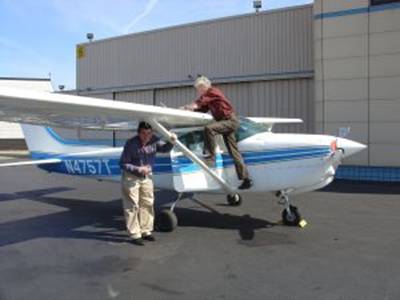 I like to do these Hudson trips at night, for a couple of
reasons. My passengers are often
first-time fliers in small planes, so the lack of turbulence at night makes for
a more comfortable flight for them.
Second, the night view of Manhattan
is absolutely spectacular, much more so than during the day. Third, and this is my most important reason,
there is very little traffic over the Hudson
at night and, what traffic there is, is very visible. The Hudson
is crowded with planes and helicopters during the day, but there are few at
night.
We flew on a Friday evening, in August; the Yankees were
playing the A’s at home and the stadium TFR wouldn’t allow us nearer than three
miles from Yankee Stadium. A three mile
circle just covers the Hudson, so the area a
mile or two north and south of the George
Washington Bridge
becomes a no-fly zone (check yankees.com
before you go and, need I tell you always to check the NOTAMs?).
There is a three-mile circle around Shea Stadium (New York Mets) also,
but it is wholly included in the Class B section that goes to the surface
around La Guardia.
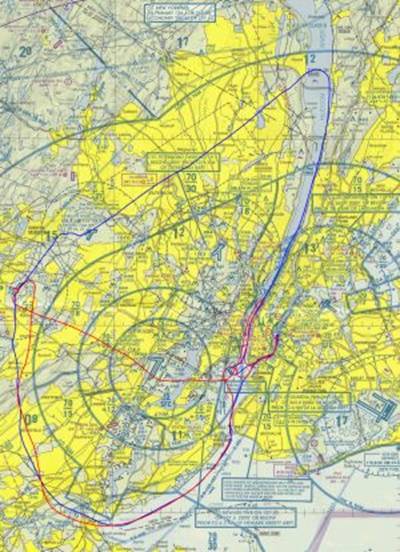
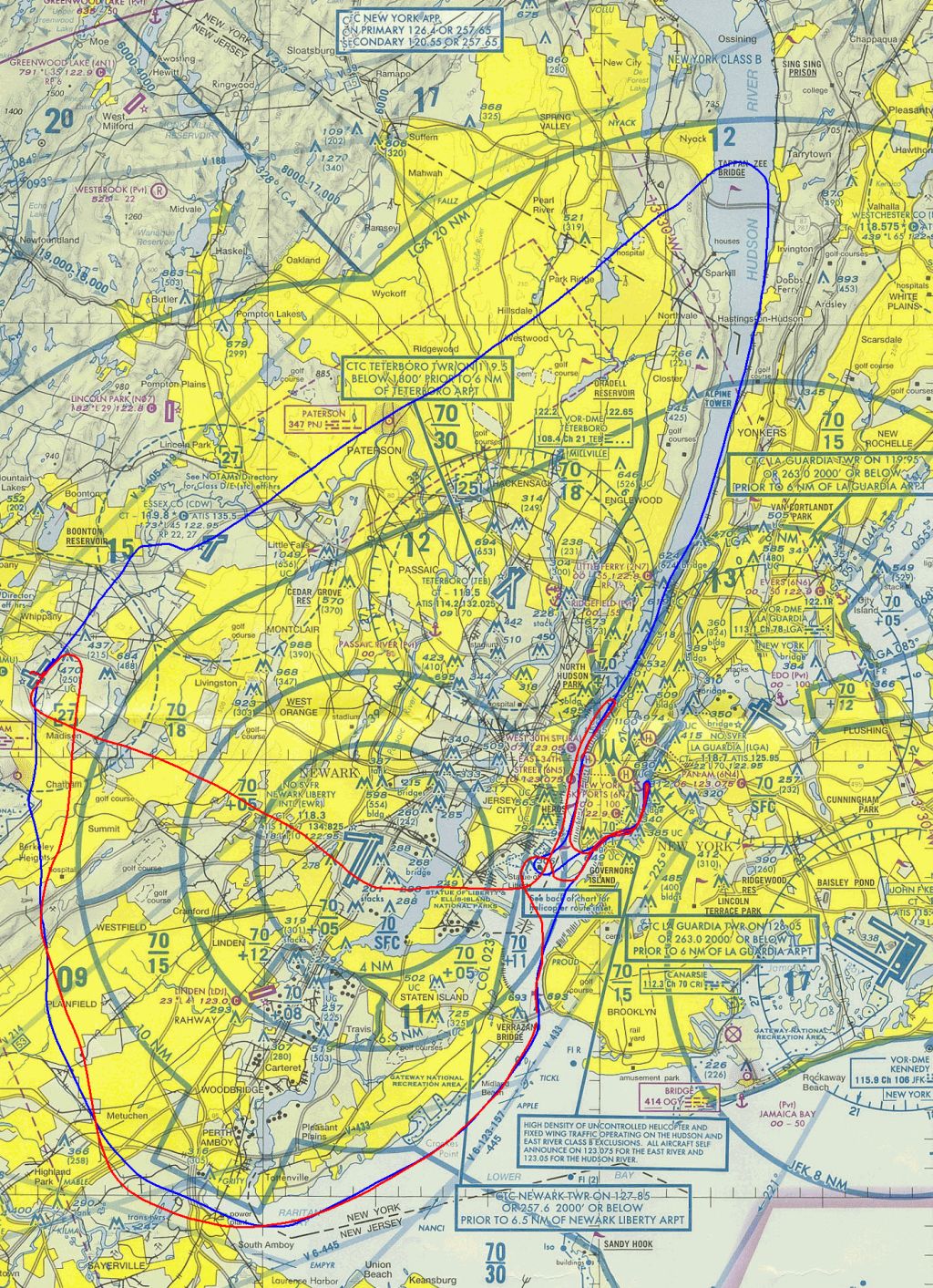
My normal route of flight would be to return to Morristown
by heading north on the Hudson to the Tappan-Zee bridge and then turn hard
left, following the 244° radial from Carmel VOR direct to Caldwell continuing
direct to Morristown (see the dark blue track on the map). From the G-W bridge on that allows me to give
the passengers an opportunity to hold the controls. We’d slowly climb from 1000 feet over the G-W Bridge
to 1800 feet – an altitude that allows approaches into Teterboro to come in
over our heads. But, as I mentioned,
that option was out. We flew the track
marked in red on the map below (click on it for a larger version).
We took off from MMU runway 5 at a few minutes after 10
pm, made a right turn-out to the south and skirted the Class Bravo 1500 foot
boundary on the outside. We looked down
at Bell Labs, Murray Hill, and my house in North Plainfield (couldn’t find the
latter in the clutter, of course) and then proceeded to the Raritan River,
a good landmark at night. There we
gently turned left, crossing the Garden
State Parkway on the south shore of the Raritan. This
avoids the appendix on the 1500-foot Class Bravo for Newark’s Runways 4 (see map, southernmost
point of both tracks).
Then it was north-east along the Staten Island coast,
while descending below 1500 feet and then down to 1000 feet to cross the
Verrazano Narrows Bridge. This is a good time to make sure you have
your taxi or landing light on.
 I always start self-announcing
on 123.05 just before the bridge. I
usually say something like
“Hudson Traffic,
Skylane, one mile from the Verrazano
Bridge, Northbound, One
Thousand.”
We then crossed over to “The Lady” and circled it
clockwise (passengers are on the right, mostly). Make sure you announce doing this – every
helicopter in the area does it too. The
helicopters usually do it at 500 feet or so.
I always stay at 800 feet or higher, for a little extra assurance. When another aircraft self-announces, by the
way, and it’s close, it is a polite and useful thing to announce your own
position and to tell them you have them in sight.
After the Lady, we swung around Governor’s Island into the
East River.
The East River has its own
self-announce frequency of 123.075. Do I
have to tell you to get an up-to-date VFR Terminal Map
for New York?
At the north end of Roosevelt Island, the East River dead-ends onto LGA’s air space. I always turn around well south of the Island, where the river is nice and wide. I warn the passengers of the G-forces and
usually make a 60°-banked turn (it’s my sadistic streak – 45° is plenty to make
the turn – but do brief your passengers
on the turn or they’ll freak out).
Watch the wind – it’s usually from the west, so a left turn is into the
wind. Rarely, winds are from the east,
however, and then a right turn makes more sense to keep the radius small. Remember, the turn takes 20 to 30 seconds and
a 10 knot wind will displace you by 300 to 450 feet during that turn; that’s
significant. Also, slow down before
turning. The radius of the turn dramatically
increases with speed. Make sure you
announce well and look behind you before turning. Do I need to tell you to be proficient in steep turns before venturing into the
East River?
This is not a place to practice them.
If you want to learn a bit more
about making optimal steep turns, look here.
We then crossed the three BMW bridges again in reverse
order (Williamsburg, Manhattan,
Brooklyn), rounded Battery Park and flew north on the Hudson.
I usually announce the Holland Tunnel, the Intrepid (aircraft carrier),
the Reservoir in Central Park and the G-W Bridge. This time we only went as far north as the
middle of Central Park. Turning around over the Hudson
is easier than over the East River: it’s
wider.
When we got close to the Lady again, I called Newark Tower
on 127.85 and asked to cut through the Class Bravo to MMU:
“Newark
Tower, Skylane Four Seven
Five Seven Tango.”
“Airplane calling, go ahead”.
“Skylane Four Seven Five Seven Tango is near The Lady, one
thousand feet, landing Morristown, request fly
over Newark Airport
to Morristown.”
“Skylane Four Seven Five Seven Tango, Newark Tower, you
are cleared into the Class Bravo airspace, climb and maintain one thousand five
hundred feet, fly directly over the Runway 04 numbers, then direct Morristown,
squawk 4321.”
“Cleared direct numbers Runway Four, direct Morristown, one thousand
five hundred, Skylane Four Seven Five Seven Tango.”
“Skylane Five Seven Tango, Newark
Tower, radar contact, one thousand
three hundred … make that one thousand four hundred, Newark altimeter two niner niner eight.”
“Two niner niner eight, Five Seven Tango.”
Before calling, make sure you can find either the Rwy 4 or
the Rwy 22 numbers because they’ll make you fly over them every time. There’s a lot of ground clutter and it’s hard
to spot Newark
airport from the Statue. A GPS helps a
lot, of course. Otherwise, look for I-78
which runs west to east towards the Statue, directly north of the airport (see
map again). Newark controllers are often pretty busy, so
don’t expect to get that clearance over EWR every time; just be prepared to fly
the long way back.
When we got Morristown
in sight, we were still at 1500 feet in Class Bravo airspace:
“Newark Tower, Skylane four seven five seven tango has Morristown airport in
sight.”
“Skylane five seven tango, frequency change approved, keep
the squawk”
“Five seven tango, roger, thank you and good night.”
By this time (a few minutes after 11), Morristown Tower
had closed. We self announced (scanned
the final approaches of Runways 5 and 23 carefully for corporate jets with
tired pilots arriving late) and landed Rwy 5 (I don’t like straight in to Rwy
31 when the tower is closed – you can’t see what’s happening on the other
runway).
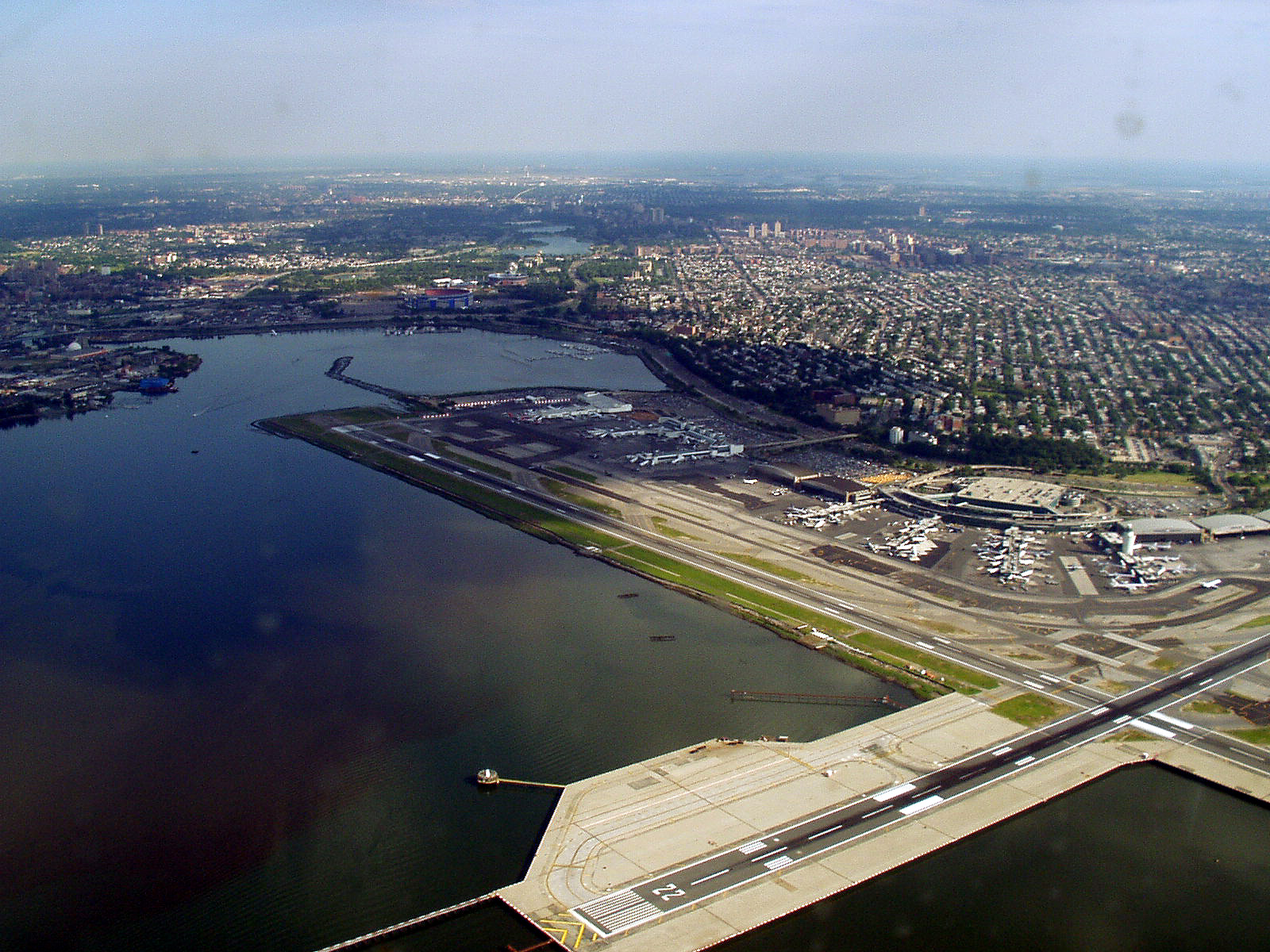
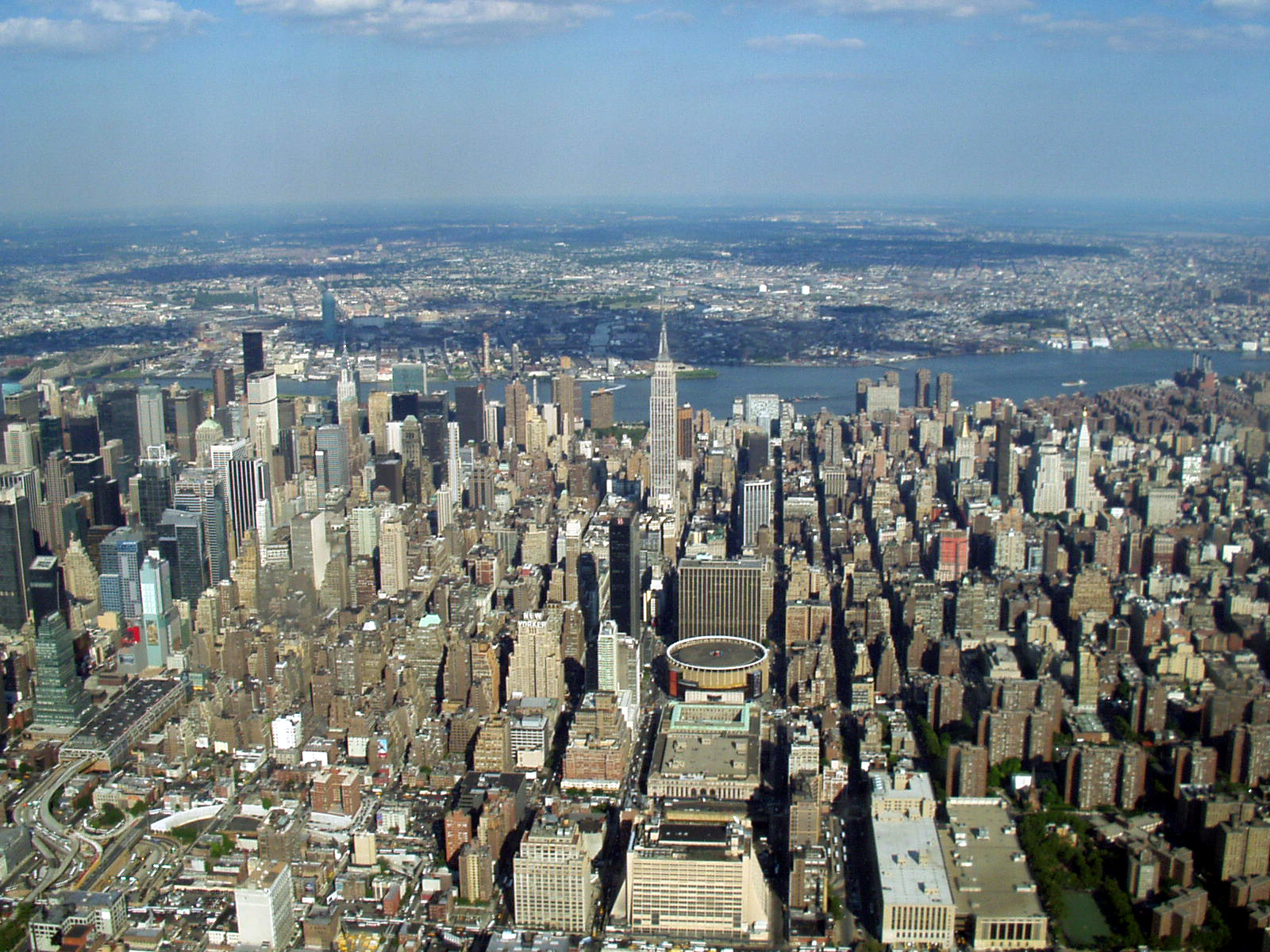
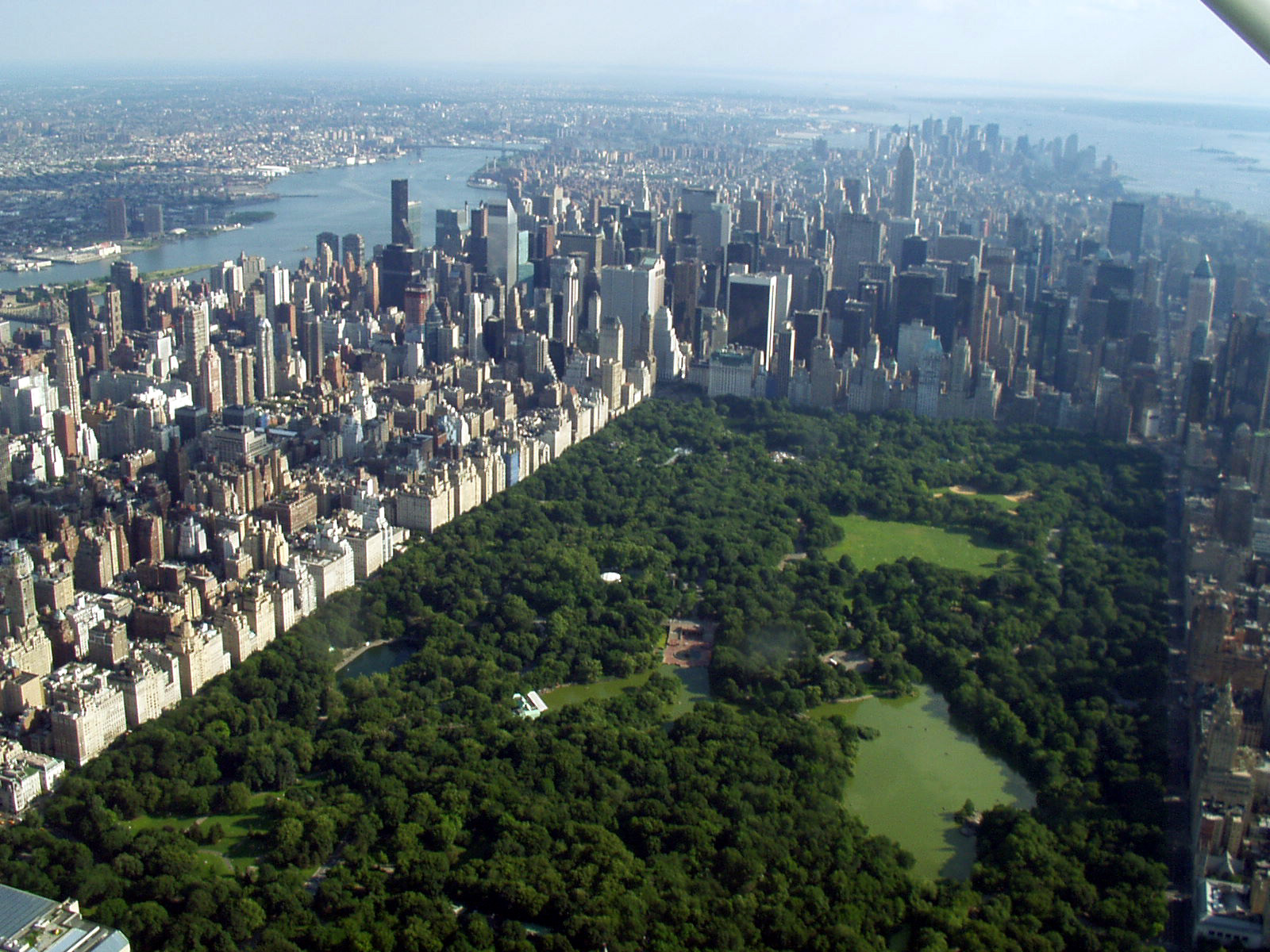
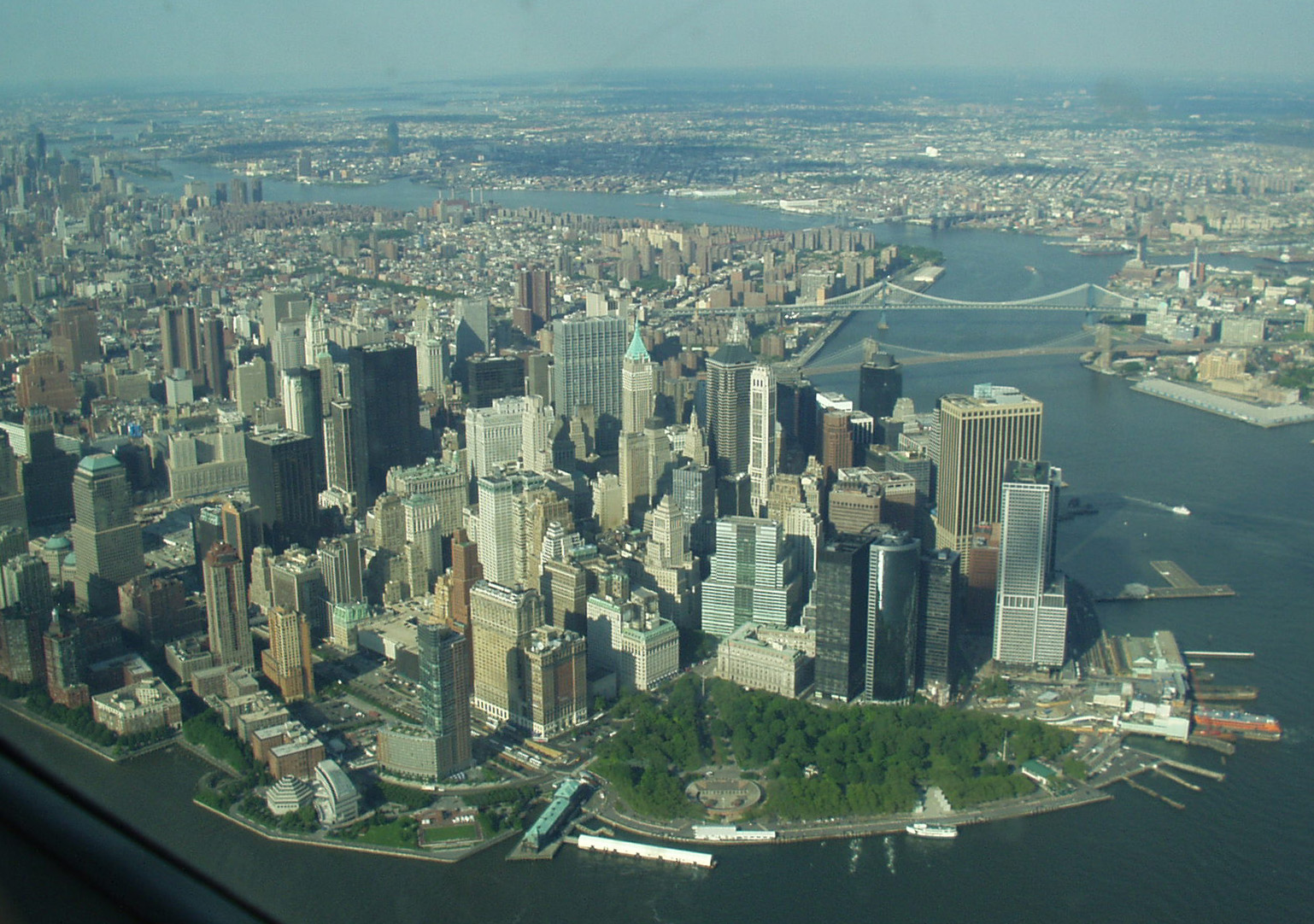
On rare occasions, you get really lucky. Returning one day from a day trip to Block
Island, I had flight following along the coast of Connecticut and I was cleared into the Class
Bravo (without asking). I told the controller
I wanted to fly to the Hudson and fly the VFR
corridor south and the controller then cleared me over the Throg’s Neck Bridge,
the tower cab of La Guardia and Central Park at 2000 feet, followed by a left
turn onto the Hudson River. One of my passengers took these photos. It gave us a uniquely new perspective on the
city from a slightly higher altitude than normal – and without sight-seeing
helicopters to worry about. Each of the
pictures can be clicked for a large version.
September 2006, Sape Mullender
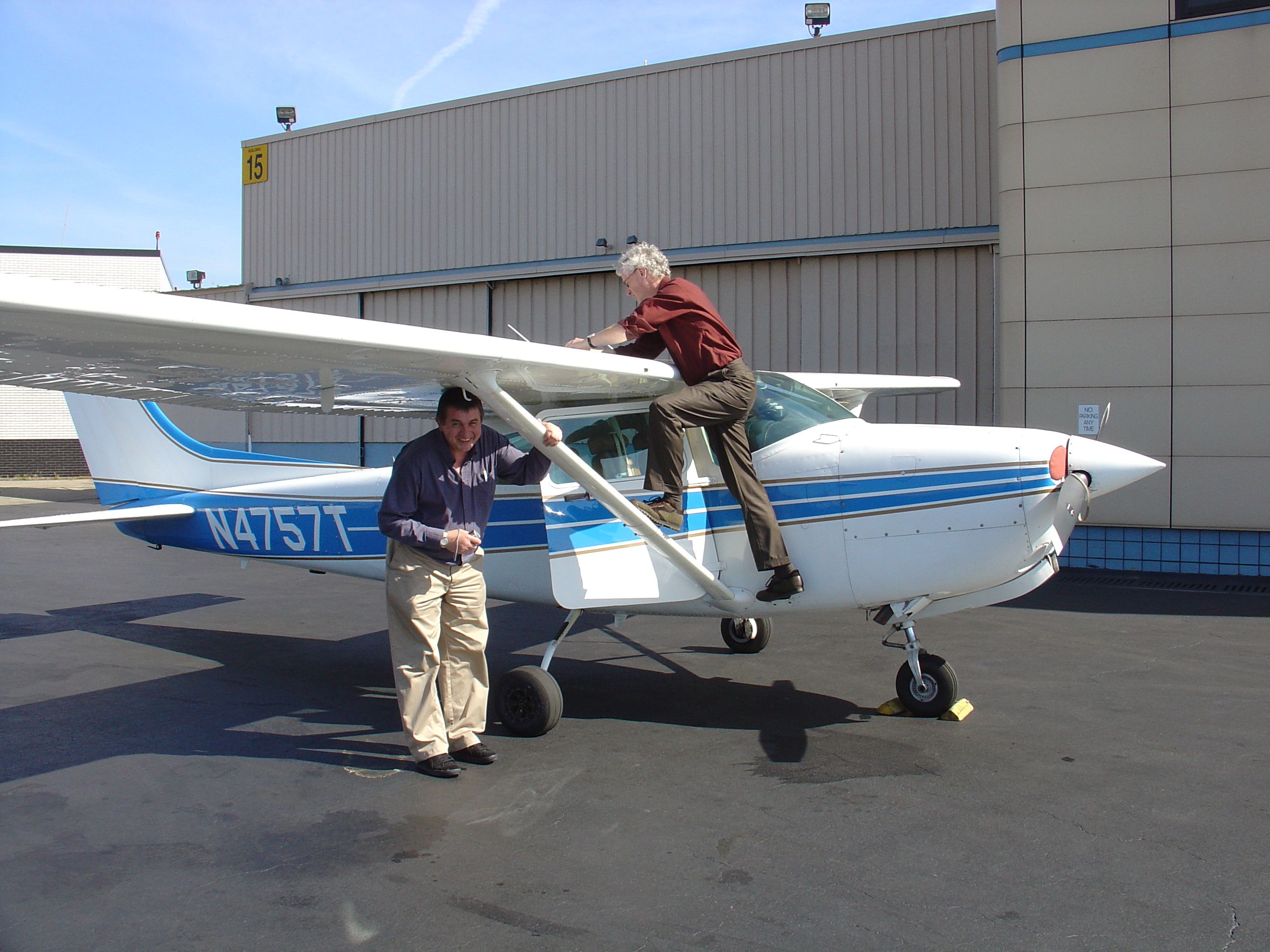 I like to do these
 I always start self-announcing
on 123.05 just before the bridge. I
usually say something like