Back to Taosong's Home Page
Publications:
Technical Report

|
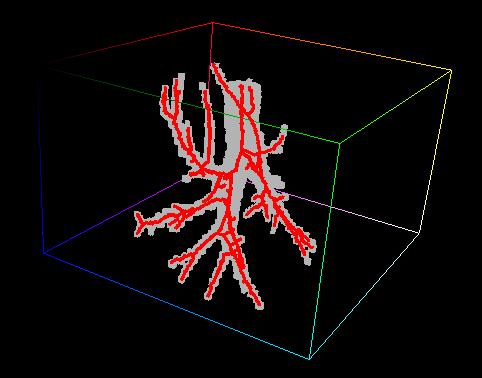
Reliable Navigation for Virtual Endoscopy Abstract: We preVirtual endoscopy provides a computerized,
non-invasive procedure for detecting anomalies inside human organs. Several
preliminary studies have demonstrated the benefits and effectiveness of such a modality.
Unfortunately, previous work can not guarantee that an existing anomaly be detected, and
it does not provide an effective navigation method for examining complex organs with
multiple branches. In this paper we introduce the concept of reliable navigation that
ensures the interior organ surface is fully examined by the physician performing the
virtual endoscopy procedure. To achieve this, we first locate inside the hollow organ a
small set of center observation points. For each observation point, there exists at least
one patch of interior surface visible to it that can not be seen from any of the other
observation points. We then link these chosen points with a path that stays in the center
of the organ. Finally, we recursively select new points inside the organ and connect them
into the path until the entire organ surface is visible from the path. During the
navigation, the physician's movement is restricted to this automatically computed path,
while he can use an intuitive and zoomable camera to explore the surface detail. We
present an encouraging result from our experiments on an airway data. |
 PostScript: mic99.ps.gz |
|
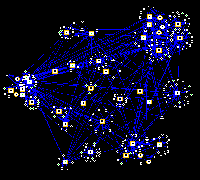
Internet-Based Network Simulator Front-End Abstract: We present a Java-based interactive visual interface to
network simulators. Having successfully incorporated network visualization technologies,
our system provides an effective |
| PostScript: vissym.ps.gz |
|
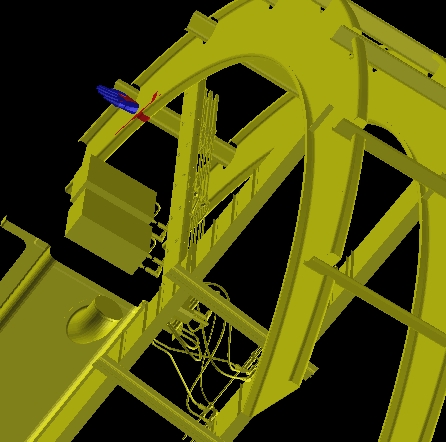
Fast Collision Detection Using QuOSPO Trees Abstract: In this paper we propose a new solution to efficient collision detection between large polygonal models. Our algorithm is based on the construction of hierarchical tree representations of models using a new bounding volume data structure: Quantized Orientation Slabs with Primary Orientations (QuOSPOs). A QuOSPO tree provides a tight approximation to the original model at each level, and supports a conservative yet very efficient overlap checking algorithm. It essentially combines and extends advantages of two leading bounding volume structures: OBBs and k-dops. Our experiments and analysis demonstrate that this new structure is substantially faster for collision detection than existing methods. |
| PostScript: QUOSPO.ps.gz
|
|
Constructing Interactive Network Visual Interface Abstract: We present an object-oriented system for the interactive visualization of complex, hierarchical, and time varying networks. Our system consists of three core components, a unified structure for the acquisition, storage, and query of general network data, a C++ abstract network base class for the handling of common functionality of a network visual interface, and a methodology of using script language such as Tcl/Tk for the implementation of user interface. We have also implemented and incorporated a suite of innovative network views into the system. The main contribution of the system is that it provides an open, unified, and efficient framework for the development of enhanced visual interfaces. |
Wavelet-Assisted Volume Ray Casting Abstract: We propose a new wavelet-assisted volume ray casting
algorithm. The main idea is to use the wavelet coefficients for detecting the local
frequency, and decide the appropriate sampling rate along the ray according to the maximum
frequency. Our algorithm is to first apply the 3D discrete wavelet transform on the
volume, then create an index volume to indicate the necessary sampling distance at each
voxel. During ray casting, the original volume is traversed in the spatial domain, while
the index volume is used to decide the appropriate sampling distance. We demonstrate that
our algorithm provides a framework for approximating the volume rendering at different
levels of quality in a rapid and controlled way. |
|
Collision Detection for Volumetric Objects Abstract: We propose a probability model for the handling of complicated interactions between volumetric objects. In our model each volume is associated with a "probability map" that assigns a "surface crossing" probability to each space point according to local volume properties. The interaction between two volumes is then described by finding the intersecting regions between the volumes, and calculating the "collision probabilities" at each intersecting point from the surface crossing probabilities. To enable fast and efficient calculations, we introduce the concept of a distance map and develop two hierarchical collision detection algorithms, taking advantage of the uniform structure of volumetric datasets. |
|
Integrated Volume Compression and Visualization Abstract: A novel volumetric data visualization scheme is proposed and implemented in this work that renders 2D images directly from compressed 3D data sets. The novelty of this algorithm is that rendering is performed on the compressed representation of the volumetric data without pre-decompression. As a result, the overheads associated with both data movement and rendering processing are significantly reduced. The proposed algorithm generalizes previously proposed whole-volume frequency-domain rendering schemes by first dividing the 3D data set into subcubes, transforming each subcube to a frequency-domain representation, and applying the Fourier Projection Theorem to produce the projected 2D images according to given viewing angles. Compared to the whole-volume approach, the subcube-based scheme not only achieves higher compression efficiency by exploiting local coherency, but also improves the quality of resultant rendering images because it approximates the occlusion effect on a subcube by subcube basis. |
|
Virtual Voyage: Interactive Navigation in the Human Colon Abstract: Virtual colonoscopy is a non-invasive computerized
medical procedure for examining the entire colon to detect polyps. We present an
interactive virtual colonoscopy method, which uses a physically-based camera control model
and a hardware-assisted visibility algorithm. By employing a potential field and rigid
body dynamics, our camera control supplies a convenient and intuitive mechanism for
examining the colonic surface while avoiding collisions. Our Z-buffer-assisted visibility |
|
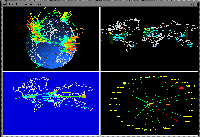
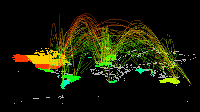
3D Geographic Network Displays Abstract: Many types of information may be represented as graphs or networks with the nodes corresponding to entities and the links to relationships between entities. Often there is geographical information associated with the network. The traditional way to visualize geographic networks employs node and link displays on a two-dimensional map. These displays are easily overwhelmed, and for large networks become visually cluttered and confusing. To overcome these problems we have invented five novel network views that generalize the traditional displays. Two of the views show the complete network, while the other three concentrate on a portion of a larger network defined by connectivity to a given node. Our new visual metaphors retain many of the well-known advantages of the traditional network maps, while exploiting three-dimensional graphics to address some of the fundamental problems limiting the scalability of two-dimensional displays. |
|
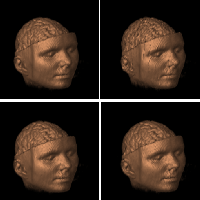
Abstract: We present new volume rendering techniques for efficiently generating high quality stereoscopic images and propose criteria to evaluate stereo volume rendering algorithms. Specifically, we present fast stereo volume ray casting algorithms using segment composition and linearly-interpolated re-projection. A fast stereo shear-warp volume rendering algorithm is also presented and discussed. |
|
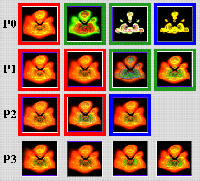
Generation of Transfer Functions with Stochastic Search Techniques Abstract: This paper presents a novel approach to assist the user in exploring appropriate transfer functions for the visualization of volumetric datasets. The search for a transfer function is treated as a parameter optimization problem and addressed with stochastic search techniques. Starting from an initial population of (random or pre-defined) transfer functions, the evolution of the stochastic algorithms is controlled by either direct user selection of intermediate images or automatic fitness evaluation using user-specified objective functions. This approach essentially shields the user from the complex and tedious ``trial and error'' approach, and demonstrates effective and convenient generation of transfer functions. |
|
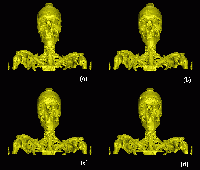
Controlled Topology Simplification Abstract: We present a simple, robust, and practical method for object simplification for applications where gradual elimination of high frequency details is desired. This is accomplished by converting an object into multi-resolution volume rasters using a controlled filtering and sampling technique. A multi-resolution triangle-mesh hierarchy can then be generated by applying the Marching Cubes algorithm. We further propose an adaptive surface generation algorithm to reduce the number of triangles generated by the standard Marching Cubes. Our method simplifies the topology of objects in a controlled fashion. In addition, at each level of detail, multi-layered meshes can be used for an efficient antialiased rendering. |
|
Voxel-Based Object Simplification Abstract: We present a simple, robust, and practical method for object simplification for applications where gradual elimination of high frequency details is desired. This is accomplished by sampling and low-pass filtering the object into multi-resolution volume buffers and applying the marching cubes algorithm to generate a multi-resolution triangle-mesh hierarchy. Our method simplifies the genus of an object and can also help existing object simplification algorithms achieve better results. At each level of detail a multi-layered mesh is generated for optional efficient antialiased rendering. |
|
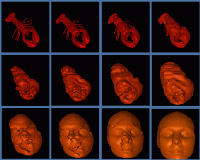
Abstract: This paper presents a technique for performing volume morphing between two volumetric datasets in the wavelet domain. The idea is to decompose the volumetric datasets into a set of frequency bands, apply smooth interpolation to each band, and reconstruct to form the morphed model. In addition, a technique for establishing a suitable correspondence among object voxels is presented. The combination of these two techniques results in a smooth transition between the two datasets and produces morphed volume with fewer high frequency distortions than those obtained from spatial domain volume morphing. |
|
VolVis: A Diversified Volume Visualization System Abstract: VolVis is a diversified, easy to use, extensible, high performance, and portable volume visualization system for scientists and engineers as well as for visualization developers and researchers. VolVis accepts as input 3D scalar volumetric data as well as 3D volume-sampled and classical geometric models. Interaction with the data is controlled by a variety of 3D input devices in an input device-independent environment. VolVis output includes navigation preview, static images, and animation sequences. A variety of volume rendering algorithms are supported, ranging from fast rough approximations, to compression-domain rendering, to accurate volumetric ray tracing and radiosity, and irregular grid rendering. |
|
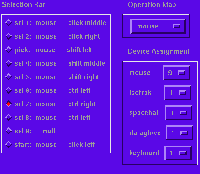
Virtual Input Devices for 3D Systems Abstract: The device unified interface is a generalized and easily expandable protocol for the communication between applications and input devices. The key idea is to unify various device data into the parameters of a so-called ``virtual input device.'' The device information-base, which includes device dependent information, is also incorporated into the virtual input device. Using the device unified interface, system builders are able to design their applications independent of the input devices as well as utilize the capabilities of several devices in the same application. |
Navigation and Animation in a Volume Visualization System Abstract: The VolVis system for volume visualization supports
diverse applications and requirements by comfortably housing numerous visualization
algorithms and methods within a consistent and well organized framework. A Navigation and
Animation subsystem has been incorporated into VolVis to allow the user to quickly specify
complex maneuvering and animation sequences. Navigation is controlled by 3D input devices.
VolVis includes a unified protocol for communicating with input devices, allowing
for input device independent development. |
Non-Existence of the Wavelet Slice-Projection Theorem Abstract: The relation between the wavelet transform and the
projection of a function is presented. We prove that for a high dimension function, the
projection along a certain view direction can not be accurately calculated from the
wavelet coefficients of the function with asymptotically efficiency |