March 17: Michale S. Fee
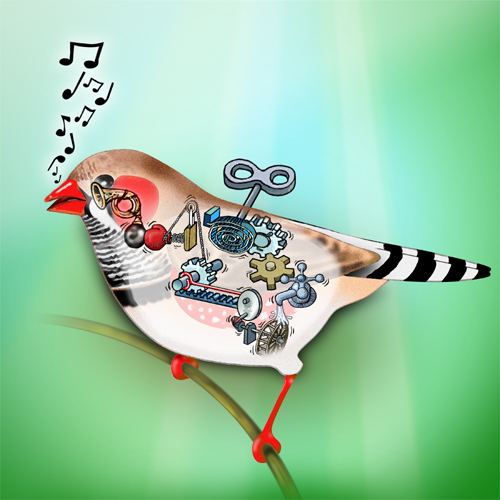
"Bird Songs: The Machine Behind the Music"
Abstract
Songbirds, like humans, learn their species-typical vocalizations. Also
like humans, songbirds learn to 'speak' from their parents in a series
of stages: first they just listen, then they begin to babble, and
gradually their babbling sounds more and more like an adult. This
striking similarity with human vocal behavior has driven recent research
on how the songbird brain makes all of this happen. The avian brain
areas involved in song control have been identified, and it has recently
been shown that some of these areas are remarkably similar to parts of
the human brain involved in learning sequences of actions. The race is
on to understand the basic neural circuits that produce this fascinating
behavior, not just in songbirds, but in our brains as well.
Biography
Michale Fee studied physics at the University of Michigan and earned
his PhD in physics from Stanford University where he made ridiculously
precise measurements of energy levels in antimatter atoms to test
quantumelectrodynamics (which passed with flying colors). Wanting to do
research in an area where the answer isn't already known, he decided to
study the brain. Since 1996 Michale has been a member of the Biological
Computation Research Department at Bell Labs, Lucent Technologies,
studying fundamental biophysical and circuit mechanisms of sequence
generation in the brain. He also enjoys playing the piano and flying.