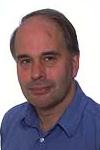
 Robert Calderbank received the B.S. degree in 1975 from Warwick
University, U.K., the M.S. degree in 1976 from Oxford University,
U.K., and the Ph.D. degree in 1980 from the California Institute of
Technology, Pasadena, all in mathematics.
He joined AT&T Bell Laboratories in 1980, and prior to the split of AT&T and Lucent, he was a Department Head in the Mathematical Sciences Research Center at Murray Hill, NJ. He is now Director of the Information Sciences Research Center at AT&T Labs-Research in Florham Park, NJ. His research interests range from algebraic coding theory to wireless data transmission to quantum computing. At the University of Michigan and at Princeton University he has developed and taught an innovative course on bandwidth efficient communication.
From 1986 to 1989, Dr. Calderbank was Associate Editor for Coding Techniques, and recently completed a term as Editor-in-Chief for the IEEE Transactions on Information Theory. He was also Guest Editor for the Special Issue of the IEEE Transactions on Information Theory dedicated to coding for storage devices. He served on the Board of Governors of the IEEE Information Theory Society from 1990 to 1996. He received the 1995 Prize Paper Award from the Information Theory Society for his work on the Z4 linearity of the Kerdock and Preparata codes (jointly with R. Hammons, Jr., P. V. Kumar, N. J. A. Sloane, and P. Solé).
Quantum Error Correcting Codes and Quantum Cryptography
Dr. Peter Shor, AT&T Research Laboratories
When quantum computers were first proposed, it was widely believed that large-scale quantum computing would be infeasible, because it appeared impossible to correct errors on a quantum computer without disturbing the state of, and thus invalidating, the computation. Quantum error correcting codes were invented to circumvent this difficulty; these codes can be used to correct any likely error in an encoded quantum state without disturbing the state. Recently, a connection was discovered between quantum codes and the first application of the strange properties of quantum mechanics to computer science, namely the 1984 quantum key distribution protocol of Bennett and Brassard. It took over a decade to rigorously prove that this protocol was secure against an eavesdropper, and the first proofs were quite complicated. Recently, John Preskill and I found a simple proof by relating the security of the Bennett and Brassard protocol to the efficacy of CSS (Calderbank-Shor-Steane) codes, a class of quantum error correcting codes. In this talk, I introduce the fundamentals of quantum error correction and show its relationship to quantum key distribution.
Viewgraphs: [postscript] [pdf]
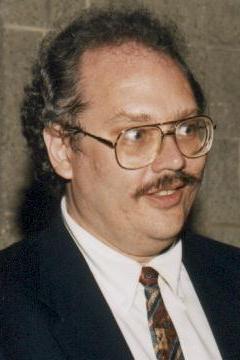 Peter Shor was born in 1959 in New York City, and grew up in Washington,
D.C. and in the San Francisco Bay area. He received a B.S. in Mathematics
from Caltech in 1981, and a Ph.D. in Applied Mathematics from M.I.T. in
1985. After a one-year postdoctoral fellowship at the Mathematical Sciences
Research Institute in Berkeley, he took a job at AT&T Bell Laboratories and
has been at AT&T since.
Until 1994, Dr. Shor worked mainly on algorithms for conventional computers (combinatorial algorithms, computational geometry and average-case analysis of algorithms) and also did research in probability and combinatorics. In 1994, after thinking about the problem on and off for nearly a year, he discovered an algorithm for factoring large integers into primes on a (hypothetical) quantum computer. Since then, Dr. Shor has spent most of his research time investigating quantum computing and quantum information theory.
In 1998, Dr. Shor was made an AT&T Fellow, received the Nevanlinna Prize at the International Congress of Mathematicians in Berlin and the Quantum Communications Award at the Quantum Communication and Measurement conference in Evanston, Illinois. In 1999, he received a Goedel prize for best paper in the field of theoretical computer science, a MacArthur Fellowship from the MacArthur Foundation, and the Dickson Prize in Science from Carnegie-Mellon University.
Frames Everywhere
Dr. Jelena Kovacevic, Bell Laboratories
Frames have become ubiquitous. They started as a mathematical theory by Duffin and Schaeffer, who provided an abstract framework for the idea of time-frequency atomic decomposition by Gabor. The theory then laid largely dormant until 1986 with the publication of work by Daubechies, Grossman and Meyer. Since then, frames have evolved into a state-of-the-art signal processing tool. Frames, or redundant representations, have been used in different areas under different guises. Perfect reconstruction oversampled filter banks are equivalent to frames in the space of square-summable sequences, described by Cvetkovic and Vetterli. Frames show resilience to additive noise as well as numerical stability of reconstruction. They have also demonstrated resilience to quantization. Several works exploit the resilience of frame expansions to coefficient losses as well as the greater freedom to capture significant signal characteristics. Frames have been used to design unitary space-time constellations for multiple-antenna wireless systems. Finally, although a well-known result by a Russian mathematician M.A. Naimark -- Naimark's Theorem -- has been widely used in frame theory in the past few years, only recently have researchers recast certain quantum measurement results in terms of frames. In this talk, I will examine frames and their various guises.
Viewgraphs: [postscript] [pdf]
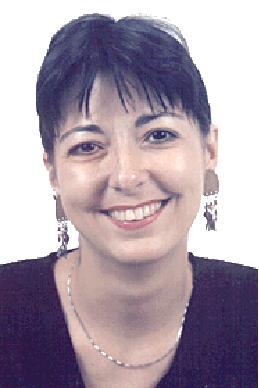 Jelena Kovacevic received the Dipl. Electr. Eng. degree from the Electrical
Engineering Department, University of Belgrade, Yugoslavia, in 1986, and the
Master of Science and Ph.D. degrees from Columbia University, New York, NY,
in 1988 and 1991, respectively.
In November 1991, she joined AT&T Bell Laboratories (now Lucent Technologies), Murray Hill, NJ, as a Member of Technical Staff. In the Fall of 1986, she was a Teaching Assistant at the University of Belgrade. From 1987 to 1991, she was a Graduate Research Assistant at Columbia University. In the summer of 1985, she worked for Gaz de France, Paris, France, during the summer of 1987 for INTELSAT, Washington, D.C., and in the summer of 1988 for Pacific Bell, San Ramon, CA. She is also an Adjunct Professor at Columbia University. Her research interests include wavelets, multirate signal processing, data compression and signal processing for communications.
Dr. Kovacevic received the Belgrade October Prize, highest Belgrade prize for student scientific achievements awarded for the Engineering Diploma Thesis in October 1986 and the E.I. Jury Award at Columbia University for outstanding achievement as a graduate student in the areas of systems, communication or signal processing. She is a co-author (with Martin Vetterli) of the book ``Wavelets and Subband Coding'', Prentice Hall, 1995. She served as an Associate Editor of the IEEE Transactions on Signal Processing, as a Guest Co-Editor (with Ingrid Daubechies) of the Special issue on wavelets of the Proceedings of the IEEE and as Guest Co-Editor (with Martin Vetterli) of the special issue on transform coding of the Signal Processing Magazine. She is on the Editorial Boards of the Journal of Applied and Computational Harmonic Analysis, Journal of Fourier Analysis and Applications and the Signal Processing Magazine. Dr. Kovacevic is a Member-at-Large of the IEEE Signal Processing Society Board of Governors and the Chair of the IEEE Signal Processing Society New Directions Committee. She served on the IMDSP Technical Committee of the Signal Processing Society of the IEEE and was a General Co-Chair (with Jan Allebach) of the Ninth Workshop on Image and Multidimensional Signal Processing.